MyPortugalHoliday.com
The best independent guide to Ericeira
MyPortugalHoliday.com
The best independent guide to Ericeira
Ericeira beaches; a beach guide for 2026
Ericeira is the only town in Europe whose coastline has been formally designated a World Surfing Reserve, and that single fact tells you most of what you need to know about why people come here. In just an 8km stretch of coast, the Atlantic meets a series of rocky headlands and reef shelves that together produce seven world-class waves. It is the density of these breaks, all within a few minutes' drive, that has transformed what was once a fishing town into a destination surfers travel across continents to reach.
What many first-time visitors do not realise is that Ericeira also works perfectly well for people who have no intention of ever stepping on a surfboard. Tucked below the town's whitewashed houses are two sheltered coves, protected from the swell by the harbour wall and a high rocky headland, where the water stays calm enough for swimming and for children to play at the water's edge. It is this combination of surfing beaches stretching both north and south of the town and sheltered bathing in the centre that makes Ericeira a more interesting choice than surf-focused destinations such as Peniche, further up the coast.
My Portuguese wife and I have lived in and explored this region since 2001, and everything you will read in this guide is drawn from our two decades of first-hand knowledge of the coastline. Whether you are an experienced surfer chasing the perfect wave, or a family looking for a sunny cove to spend the day, there is a beach here that will suit you. In the sections that follow, I will walk you through each of Ericeira's beaches, and help you decide which one is the right choice for the kind of day you have in mind.
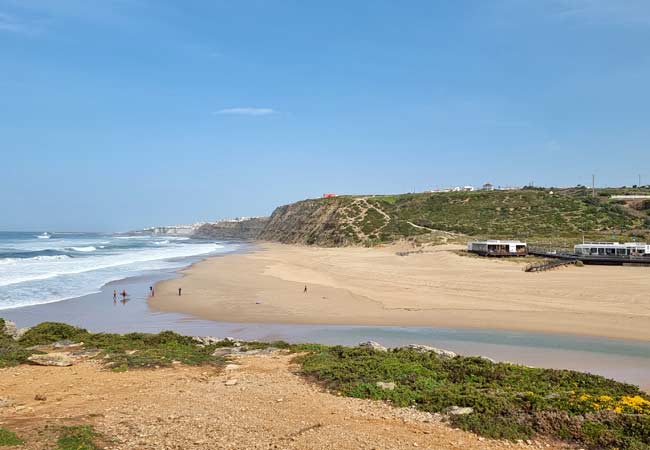
The beautiful Praia da Foz do Lizandro is my personal favourite beach of the region.
The best beaches in Ericeira
From my own experience of surfing here, and from many conversations with surfers far more accomplished than I am, these are the beaches I would point you to if waves are what you are after:
1) Praia de Ribeira d'Ilhas 2) Praia da Foz do Lizandro 3) Praia de São Julião 4) Praia do Matadouro 5) Praia de São Lourenço
When my wife or my young nieces want a relaxing day by the sea, these are the beaches I take them to:
1) Praia dos Pescadores 2) Praia do Sul 3) Praia da Foz do Lizandro 4) Praia do Norte 5) Praia de São Sebastião
The map below shows all of the beaches I cover in this guide. You may need to zoom out a little to see every point.
Key 1) Praia de São Lourenço 2) Praia dos Coxos 3) Praia de Ribeira d'Ilhas 4) Praia da Empa 5) Praia do Matadouro 6) Praia de São Sebastião 7) Praia do Norte 8) Praia dos Pescadores 9) Praia do Sul 10) Praia da Foz do Lizandro 11) Praia de São Julião
Before I take you through each beach in detail, it is worth pausing on what the "World Surfing Reserve" title actually means, because it is central to the identity of this coast and to the quality of the beaches I have listed above. This is more than a marketing label. The designation protects an 8km stretch of coast and its seven world-class waves, including those at Ribeira d'Ilhas and São Lourenço, and it reflects a community-wide commitment to preserving the local surfing culture and the natural environment for the generations who will come after us.
The Praia do Sul beach
If you are only going to visit one beach in Ericeira on a summer's day, I would send you to the Praia do Sul. It is widely regarded as the main beach of the town, and for good reason. It is also known locally as the Praia da Baleia, which means "Whale Beach", a name that harks back to an incident in the 1800s when a large whale washed ashore here. The viewpoint on the cliffs above still carries the same name, the Miradouro da Baleia, and it is worth walking up to for a great view over the bay or is magical at sunset.
The beach sits on a wide, sweeping bay, with a rocky headland on the northern side. That headland provides welcome shelter from the winds that pick up along this coast, and it is the reason the Praia do Sul was the first beach in the area to develop tourism back in the 1950s. You can still see a reminder of that history in the grand old Vila Galé hotel that overlooks the sands from the headland above.
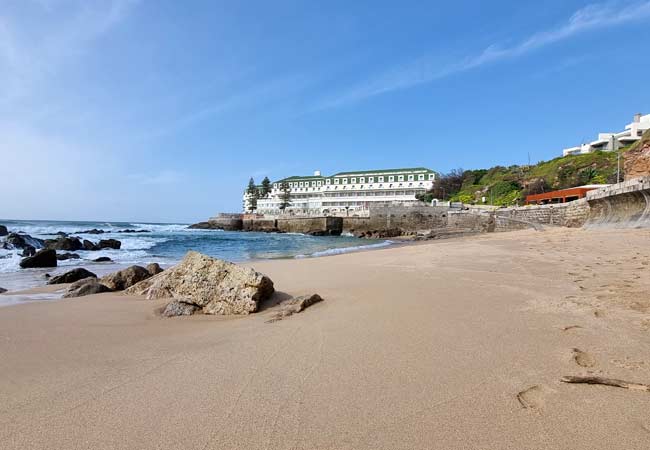
The Vila Galé hotel and the low tide rocks starting to appear
What makes this beach work so well for families is the combination of soft, golden sand and waves that are not too powerful, particularly at the northern end. At low tide, the rocks form a shallow paddling pool that my nieces have spent many happy hours splashing around in, and I have seen countless other children do the same. The one drawback I would flag is that the beach can become very busy in the peak summer months.
Facilities here are good. The Praia do Sul is awarded Blue Flag status each year, and you will find lifeguards on duty through the summer season, along with public toilets and outdoor showers. Running behind the beach is a pleasant promenade lined with cafes and restaurants, several of which have outdoor terraces and make a fine spot for a late lunch or a sunset drink. The beach sits within easy walking distance of the town centre, which is one of its great practical advantages.
On the surfing side, the Praia do Sul is not really a summer surf beach. The waves tend to be flat or small through July and August, and the northern end of the beach is generally too busy with swimmers for surfing to be safe or sensible. In autumn and winter, however, it is a different proposition. The beach has several named breaks, including Furnas on the northern headland (a powerful, long wave that comes alive on bigger swells and is suited to more experienced surfers) and Papucos down near the pier at the southern end.
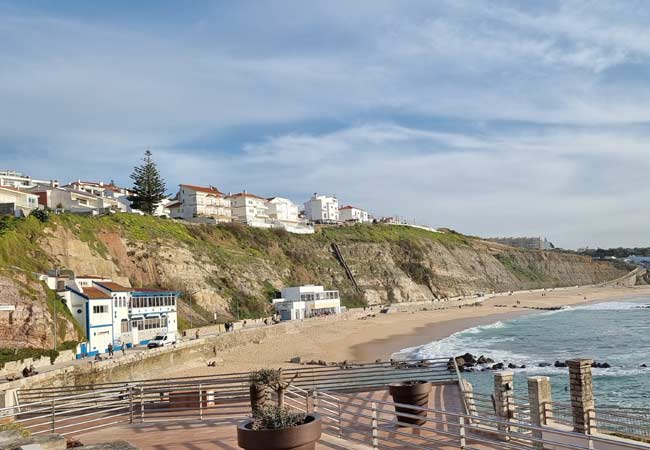
The Praia do Sul is a beautiful, sandy beach
Praia de Ribeira d'Ilhas beach
The Praia de Ribeira d'Ilhas is the most famous surfing beach in Ericeira, and if this is your first surfing trip to the region, it is where I would point you first. The beach owes its reputation to the quality and variety of its waves, with gentler conditions closer to shore for beginners and more powerful waves further out for experienced surfers.
The waves here produce consistent, right-hand point breaks, along with some superb reef breaks in front of the two headlands. The waves at the centre of the beach are the ones I would recommend for beginners, as they form over sand and in relatively deep water, which is far more forgiving when you fall.
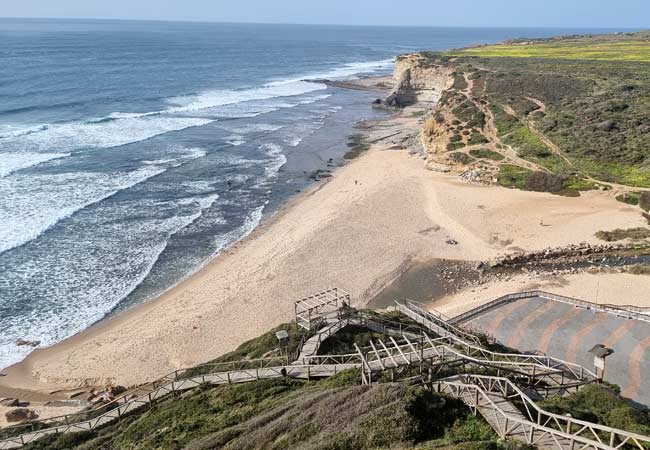
The Praia de Ribeira d'Ilhas at high tide, with the experienced surfers much further out to sea
The one issue I would be honest with you about is the crowds. The water at Praia de Ribeira d'Ilhas can become very busy, and you will often be sharing it with a wide mix of experienced surfers and complete novices, many of whom have just stepped out of a surf school lesson. It is worth staying alert in the line-up.
Off the water, the beach is surrounded by attractive natural scenery, sitting in a valley between two large headlands that provide a degree of shelter from the wind. That said, the overwhelming majority of visitors here are drawn by the surfing. If you are travelling as a couple or a family and surfing is not your main interest, I would steer you towards the Praia da Foz do Lizandro instead, which has far more to offer in the way of beach atmosphere.
Insight: At the top of the cliff, on the main road back into Ericeira, you will find a wonderful viewpoint called the Miradouro Ribeira d'Ilhas, along with the Homenagem ao Surfista statue. It is well worth a few minutes of your time, especially late in the afternoon when the light on the water is at its best.
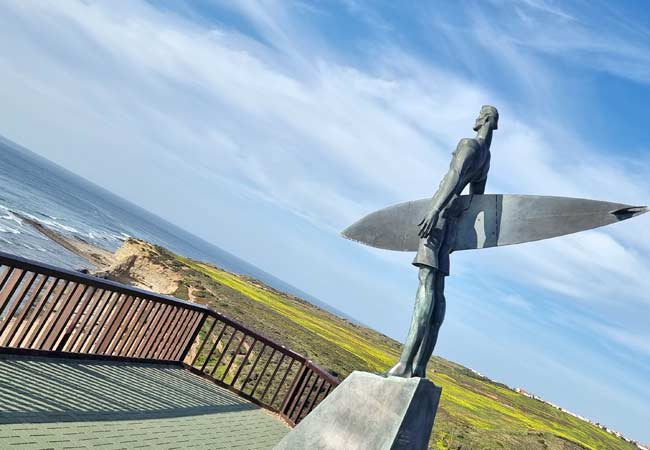
The Homenagem ao Surfista at the Miradouro Ribeira d'Ilhas viewpoint
The Praia dos Pescadores beach
The Praia dos Pescadores sits at the heart of Ericeira, and in a very real sense the town was built around it. This was the working harbour from which the community originally made its living, and it remains one of the few natural harbours along the coastline between Cascais and Peniche. The beach itself lies at the base of the town's towering cliffs, with the fishing boats still stored along the back of the sand when they are not at sea. If you arrive in the morning, you can often watch them coming in with the catch of the day
Of all the beaches in the area, the Praia dos Pescadores is the most sheltered. The 30-metre cliffs at the back of the beach give it near-total protection from the winds that sweep down the coast, and the harbour wall to the north breaks up the swell and the currents that can make swimming elsewhere less comfortable. It is, quite simply, the calmest water you will find in town, and for that reason it is where I take my young nieces when they want to swim safely.
The one drawback is that the beach is relatively small, so on a warm summer's day it fills up quickly. If you want a good spot, I would recommend arriving before 10am.
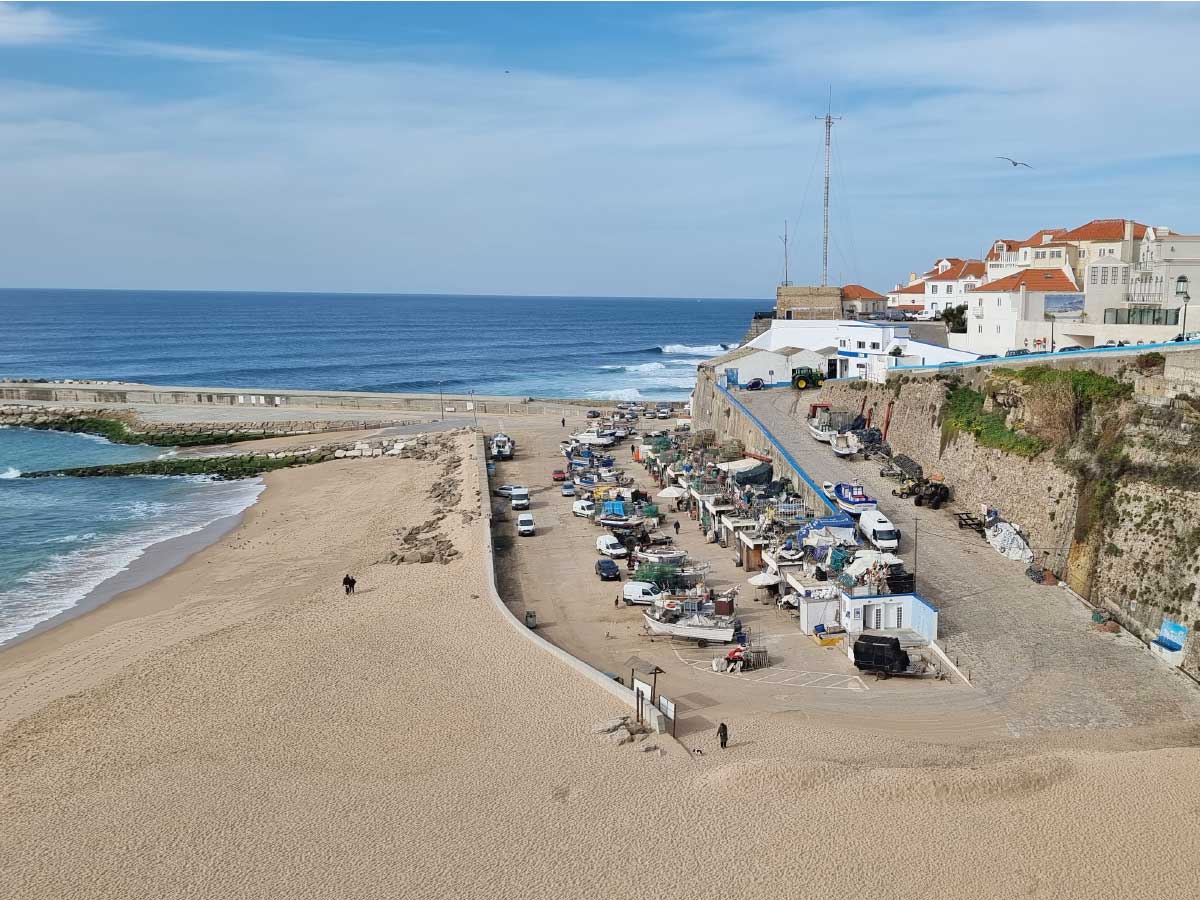
Insight: The Praia dos Pescadores played an unexpected role in Portuguese history. It was from this very beach, on 5 October 1910, that King Manuel II and the Portuguese royal family boarded fishing boats to meet the royal yacht offshore, and from there into permanent exile. That departure marked the end of the Portuguese monarchy and the beginning of the Republic. You can read about the event on a tile panel set into the wall beside the 15th-century Chapel of Saint Anthony, which sits just above the beach
Praia da Foz do Lizandro
The Praia da Foz do Lizandro is my personal favourite beach in the Ericeira region, and if I could only recommend one beach to a visiting family, this would be it. It offers excellent surfing, the largest expanse of golden sand in the area, and a lively collection of beach bars and restaurants that keep going well after the sun goes down. The one practical consideration is that it sits 2.6km south of Ericeira town, so you will need a taxi, an Uber, or the bus to reach it.
The beach takes its name from its position at the mouth of the Rio Lizandro, and the river has carved a deep valley between two headlands which has filled, over time, with soft, pale sand. It is the biggest stretch of sand in the Mafra region, and because the bay is shielded by cliffs, it tends to feel less windy than the more exposed beaches further north.
In many ways the Praia da Foz do Lizandro shares the same qualities as the Praia de Ribeira d'Ilhas, but I would say it is far better suited to families and to visitors who want to combine a beach day with good food and a relaxed atmosphere, rather than focusing purely on the surf.
One detail that I think is often underappreciated is the river itself. The Rio Lizandro runs along the southern side of the beach, and because the water is slow, shallow, it becomes a natural paddling pool for children at low tide. My nieces have spent whole afternoons splashing in it while my wife and I have lingered over lunch at one of the boardwalk restaurants.
The river is also ideal for stand-up paddleboarding and kayaking, and you can rent boards from the surf schools at the northern end of the beach.
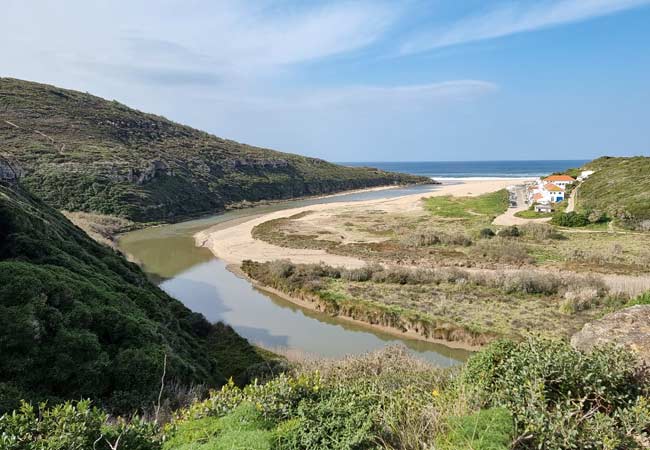
The Rio Lizandro as it meanders down to the sea
For surfers, the Praia da Foz do Lizandro is one of the best all-levels spots in the region. The seabed here is entirely sand, which is unusual for Ericeira, as most of the famous breaks further north sit over sharp, shallow reef. That sandy bottom is precisely why the surf schools favour this beach for beginners. You will find multiple peaks spread along the sand, with a left-hander at the river mouth and an A-frame producing both lefts and rights in the middle of the bay.
Conditions are best from low to mid tide, and the beach picks up swell reliably across a wide range of directions. On bigger swells, the reef breaks at the northern end (known locally as Lage dos Tubos and Limpicos) come into play, and these are better suited to more experienced surfers.
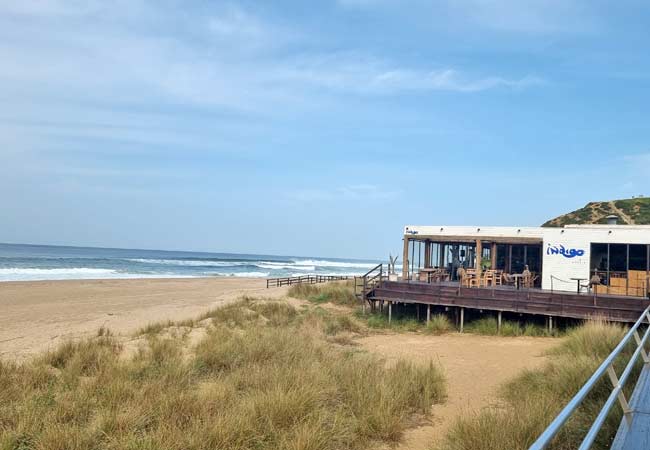
Praia de São Juliao beach
The Praia de São Julião is another of the region's strong surfing beaches, lying 4km south of Ericeira in a straight line, or 6km by the time you have driven round. The shoreline stretches for over a kilometre, which makes it the largest beach in the Ericeira region by some margin. The northern section sits within a wide river valley, while the southern end is hemmed in by tall cliffs, and because of that size and the relatively limited access, it is one of the quietest stretches of sand on this coast.
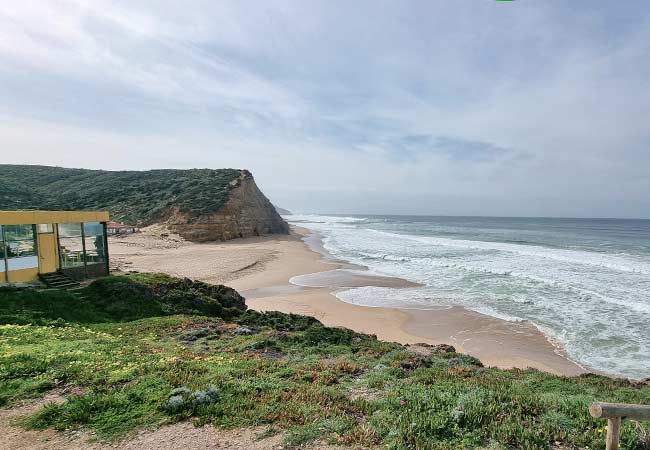
To the south of the beach, huge cliffs rise up
What tourist development there is tends to be concentrated at the northern end, where you will find the car park and a couple of beach cafes. Walk south along the sand and the atmosphere changes quickly. The wind picks up, the waves strengthen, and you are soon in territory better suited to experienced surfers than to families with towels and parasols.
I would point you to the Praia de São Julião when the Praia da Foz do Lizandro is too crowded, or when the waves there are not working. It is a useful alternative to have in your back pocket, particularly in the middle of summer.
Insight: At the top of the northern cliffs stands the Capela de São Julião, a small chapel with a beautifully tiled interior. Surrounding it is a tiny cluster of traditional Portuguese fishing cottages, and the whole village is worth ten minutes of your time before you head down to the sand.
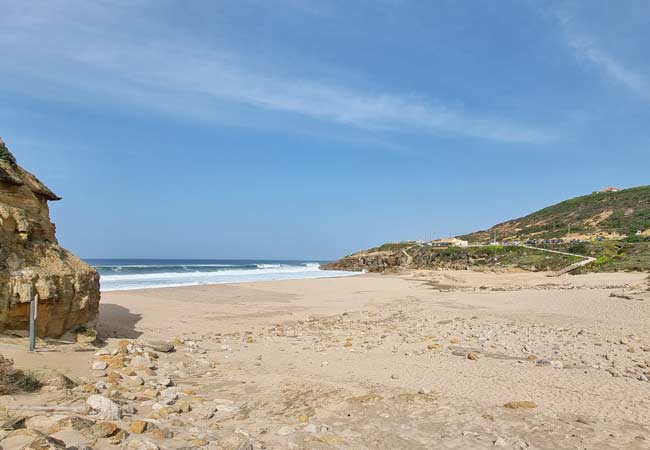
The sandy river valley of the Praia de São Juliao beach
The Praia de São Sebastião
The Praia de São Sebastião is one of the beaches I find most visitors overlook, and I think that is a small shame. It lies to the far north of the town, and it is difficult to surf here because of the submerged rock formations that sit just offshore. At high tide, a good portion of the beach itself disappears under the water. The practical result is that São Sebastião has barely any tourist development at all, and retains the wild appearance that much of this coastline has lost elsewhere.
Insight: There is a fine cliffside walk that begins at the Praia de São Sebastião and follows the coast to the Miradouro Ribeira d'Ilhas viewpoint. Along the way you will pass the Praia da Empa and the ruined Forte do Milreu, and the views out to sea are some of the best in the region. Allow around 40 minutes each way.
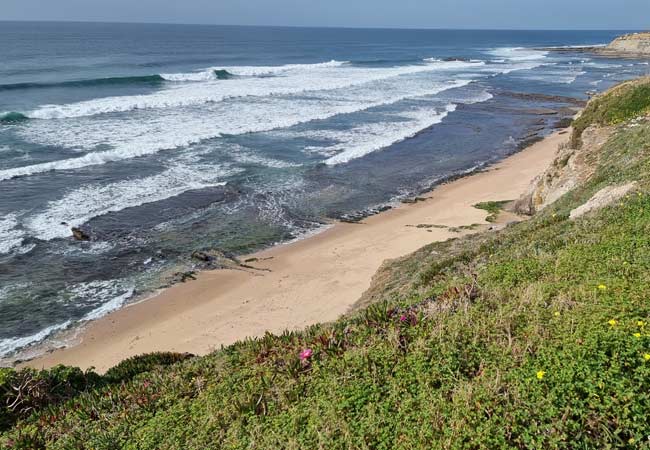
The Praia do Norte
The Praia do Norte is the third and least-visited of the beaches in Ericeira's town centre. It sits to the north of the fishing harbour wall, which means it has none of the shelter that the wall provides to the Praia do Sul and the Praia dos Pescadores on the other side. The winds reach it directly, the waves are stronger, and the currents can be lively. On a calm summer's day, however, it is a reasonable alternative to the other two town beaches when they become too busy.
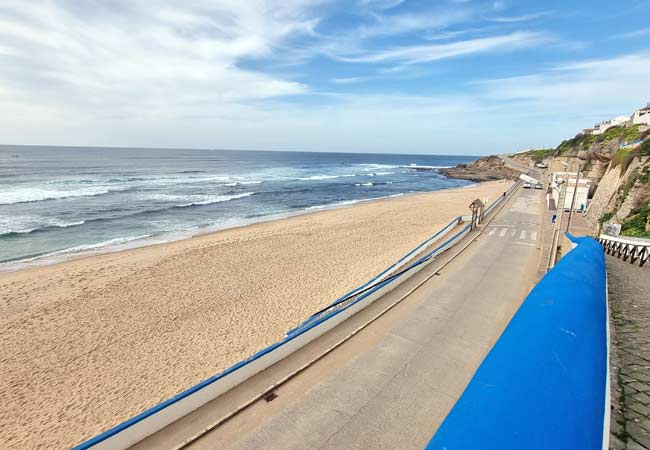
Praia do Matadouro beach
The Praia do Matadouro is a small beach just north of the Praia de São Sebastião. It is a popular spot for beginner surfers and sits close to the Quiksilver store and the surf school that operates alongside it, which is why you will often see groups of learners heading down to the sand in the morning and early afternoon.
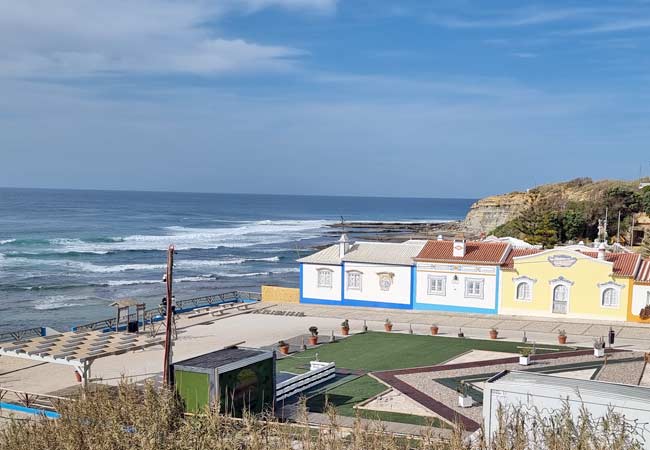
The Praia da Empa
The Praia da Empa is a rock-strewn beach with very little sand. Because of the rocks along the shoreline, it is one of the quietest beaches on this coast, but it is a serious surfing spot for experienced riders who have grown tired of the crowded waters at the Praia de Ribeira d'Ilhas.
The rocky tidal pools that appear at low tide make this an interesting beach to visit with children. You can spend an hour or two searching for the small crabs and fish that get caught in the pools as the tide retreats, and in my experience it is one of the more absorbing activities I have found for younger visitors on this coast.
Like every beach along this coastline, the experience at the Praia da Empa is shaped by the tide. At low tide, the rocks are fully exposed and the tide pools open up. At high tide, a great deal of the smaller beaches in Ericeira can almost disappear. I would always recommend checking a local tide chart before heading out, as it makes a real difference to what you will find when you arrive.
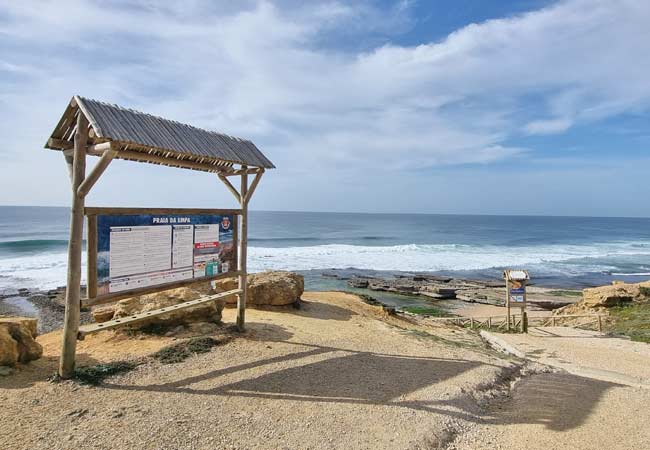
Beach Facilities and Safety
Most of the main beaches, such as Praia do Sul, Foz do Lizandro, and Ribeira d'Ilhas, are awarded Blue Flag status each year, signifying high standards of water quality, safety, and environmental management. During the high season (typically June to mid-September), these popular beaches are supervised by lifeguards. You will also find facilities like public toilets, showers, and cafes at the more developed beaches.
A word of caution: the Atlantic water here is chilly year-round, rarely exceeding 20C (68F), even in summer. Strong currents and riptides can be present, especially on days with larger waves, so always swim in lifeguarded areas and pay attention to the beach warning flags.
Discover the best of Ericeira and Central Portugal with our guides


About this guide: I'm Philip Giddings. I live in Graça, Lisbon, with my Portuguese wife Carla, whose family have been Lisboetas for generations. I've been visiting Portugal since 2001 and writing the independent guides at MyPortugalHoliday.com since 2011, which is now my full-time work. Central Portugal was where Carla and I did much of our early exploring together, and twenty-five years on we still return to the same towns every year: the beaches at Nazaré and Ericeira with family in summer, the walled streets of Óbidos, and the quieter spots inland that most itineraries skip. Carla's extended family are spread across the region, from an aunt near Évora to good friends in Tomar, which gives me firsthand insight and people to check things with on the ground.
This site has 157 guides covering Portugal, from Coimbra down to the southern Alentejo. It takes no payment from tourist boards, tour operators, or attractions for inclusion, and is funded by affiliate commissions on tour bookings, disclosed on every page that contains them. Every practical detail (ticket prices, opening hours, bus and train routes, time-slot policies) is checked against the official sources and verified in person on the trips I make through the region across the year. Read my full story here.