MyPortugalHoliday.com
The best independent guide to Central Portugal
MyPortugalHoliday.com
The best independent guide to Central Portugal
Fatima, Portugal: an independent travel guide for 2026
On 13th October 1917, more than 70,000 people gathered in a muddy field in central Portugal, and what they reported seeing that afternoon turned an obscure farming hamlet into one of the most visited pilgrimage sites on earth. The "Miracle of the Sun," as it came to be known, was the final act of six apparitions of the Virgin Mary witnessed by three young shepherd children between May and October in 1917. Lúcia dos Santos and her cousins Francisco and Jacinta Marto were aged just ten, nine and seven at the time, and their testimony would go on to shape Portuguese Catholicism for more than a century.
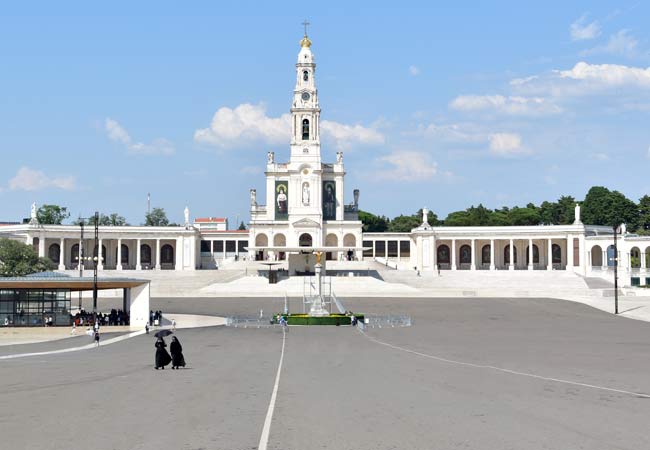
Today, Fátima draws millions of visitors each year to an immense sanctuary built around the site of those visions. The landscape is dominated by a vast open plaza flanked by two very different churches: the classical Basílica de Nossa Senhora do Rosário, with its central tower and colonnaded wings, and the colossal, starkly modern Basílica da Santíssima Trindade opposite. Between them, is the Capelinha das Aparições, the humble chapel built on the exact spot where the children said the Virgin appeared. It is here, rather than in the grand basilicas, that you will feel the spiritual weight of the place most clearly.
It is worth understanding before you arrive that Fátima is not a conventional tourist destination. This is a working place of pilgrimage, and the atmosphere is shaped by the quiet devotion of the people who come here. I have found it a moving place to spend time in even as a non-religious visitor, but it asks a different kind of attention, and the more you understand about what happened here, the more rewarding your visit will be.
I have been exploring Portugal since 2001, and together with my Portuguese wife I have returned to Fátima many times over the years, both with family members who came for devotion and friends who were culturally curious. This guide shares what we have learned, so you can plan a visit that suits your own reasons for coming, whether spiritual, cultural, or somewhere in between.
Highlights of Fatima
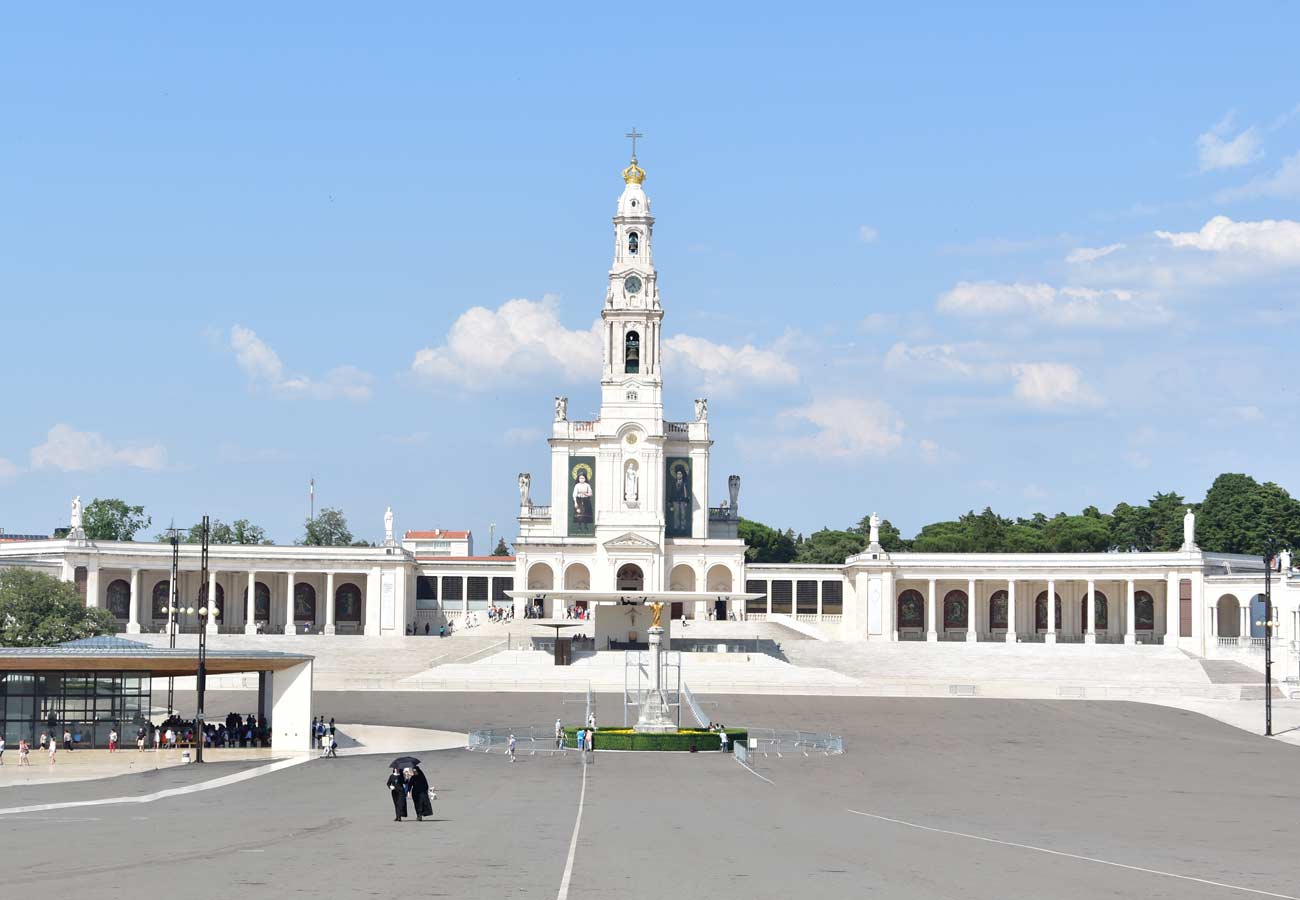
The magnificent Basílica de Nossa Senhora do Rosário.
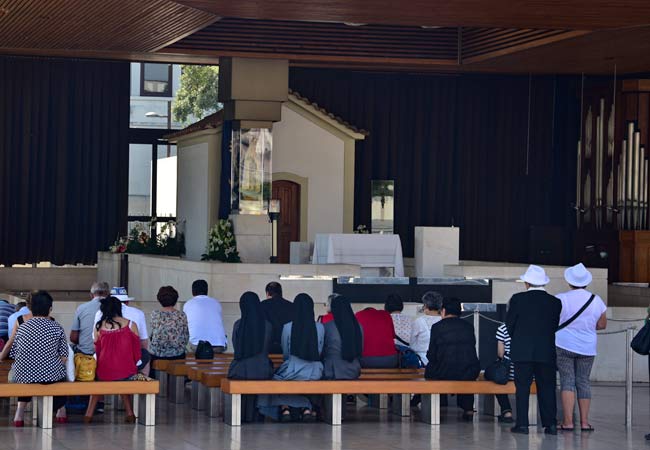
Attending a church service at the Capelinha das Aparições, where Our Lady of Fatima first appeared.
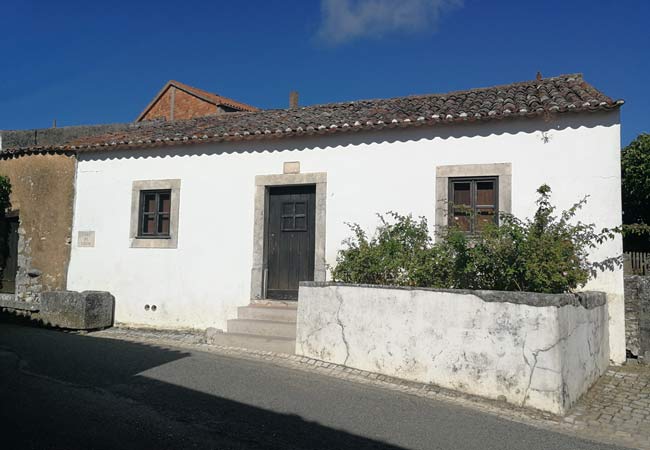
Visiting the rustic houses where the shepherd children grew up - the above image shows Casa da Lúcia.
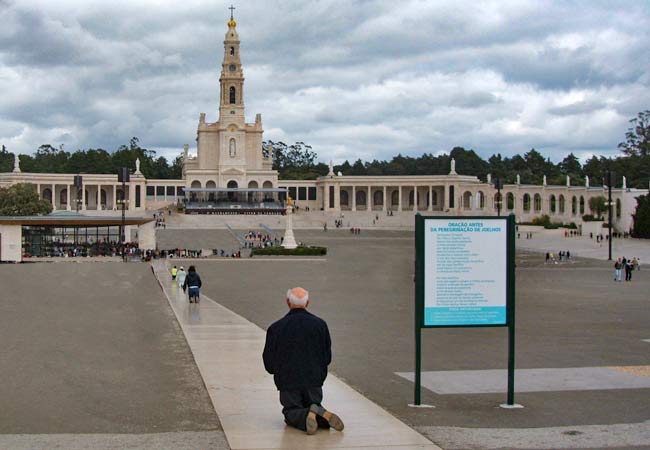
The peaceful and reflective atmosphere of the Santuário de Fátima, where devout pilgrims gather in prayer.
Is it worth visiting Fatima?
Visitors to Fátima generally fall into two categories: pilgrims seeking a spiritual experience through prayer and devotion, and cultural tourists interested in exploring one of Portugal's most significant religious sites. While their motivations differ, both can find meaningful experiences here.
For religious visitors, Fátima offers a profoundly moving experience. The Santuário de Fátima maintains a deeply reverent atmosphere where pilgrims can attend services at the Capelinha das Aparições (built on the exact site of Mary's first apparition), participate in devotional practices such as candle lighting, and visit both the magnificent Basílica de Nossa Senhora do Rosário and the grand Basílica da Santíssima Trindade. The sense of collective faith is palpable, particularly during the evening candle processions held between May and October.
For cultural visitors, Fátima presents a more modest experience. While the site holds immense religious significance, its relatively recent history (dating to 1917) means most structures are modern and somewhat plain. The only true architectural highlight is the Basílica de Nossa Senhora do Rosário; the other buildings, though impressive in scale, follow a more functional design. That said, the shepherd houses in Aljustrel offer a fascinating window into early 20th century rural Portuguese life, and the sheer scale of the sanctuary complex is worth experiencing regardless of your beliefs. Beyond the religious complex itself, however, Fátima offers limited attractions for general tourists.
For those less drawn to religious sites, nearby Tomar makes a more interesting day trip from Lisbon.
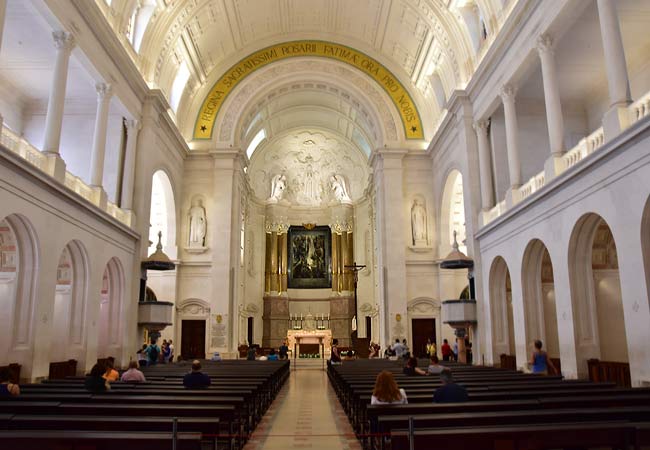
The interior of the Basílica de Nossa Senhora do Rosário
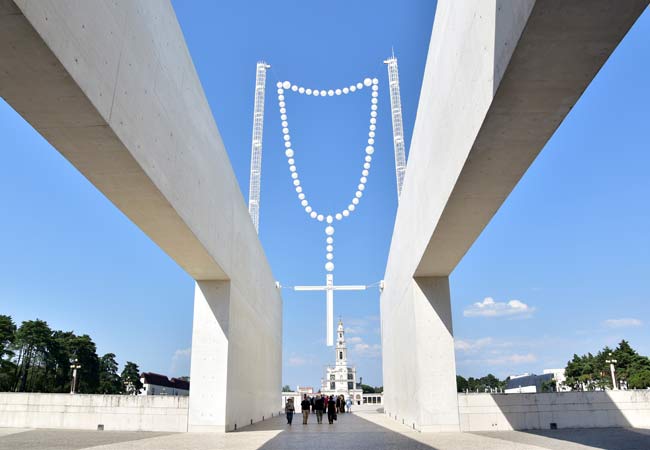
The entrance to the Basílica de Nossa Senhora do Rosário has a giant monument dedicated to the Rosary
A day trip to Fatima
Fátima can be visited as a day trip from Lisbon, involving either a 1h10m drive or 1h30m bus journey each way (public transport details are at the end of this guide).
A typical visit takes around three hours, which allows enough time to explore the religious buildings of the Santuário de Fátima, discover the shepherd houses in the village of Aljustrel (2.2km south), and visit the excellent Museu de Cera de Fátima (wax museum). However, your visit may stretch longer if you wish to attend a church service or light a candle at the Capelinha das Aparições, as queues can be very long during peak periods.
A good place to begin is the Museu Interativo, which provides a detailed overview of the site's history and helps put everything you'll see into context. From there, a tour of the Santuário de Fátima typically includes the two basilicas (Nossa Senhora do Rosário and Santíssima Trindade), the Capelinha das Aparições chapel, the Azinheira Grande tree, and the vast central plaza. Before leaving the sanctuary, the Museu de Cera de Fátima is also worth visiting, with its lifelike statues depicting the events of 1917.
Many visitors also head to the shepherd houses in the village of Aljustrel, 2.2km south of the Santuário de Fátima. These modest homes, where Lúcia Santos and Francisco and Jacinta Marto lived, have been carefully restored to their 1917 condition. Original furnishings and period items offer an authentic glimpse into rural Portuguese life in the early 20th century, and help bring the story of the three children to life.
For those with more time, the Valinhos Via Sacra (Stations of the Cross) makes for a peaceful walk through tranquil woodland, leading up to the Calvário Húngaro crucifixion monument. The 1.5km route begins at the Three Shepherds Monument roundabout, though it is easy to join the later sections from Aljustrel if you're already visiting the shepherd houses.
Along the way lies the Loca do Cabeço, a rocky hollow where the Angel of Peace made his first and final appearances to the shepherds in 1916. These angelic visitations prepared the children for the Marian apparitions that would follow the next year, making this a meaningful stop for those interested in the full story. The path to this sacred site can be found at the 11th Station of the Cross monument.
Below is an interactive map detailing the main sights of Fatima.
Legend: 1) Chapel of the Apparitions 2) Basilica of Our Lady of the Rosary 3) Basilica of the Most Holy Trinity 4) Lucia's House 5) House of Jacinta and Francisco Marto 6) Arneiro Well (Poço do Arneiro) 7) Valinhos Stations of the Cross 8) Angel's Hollow (Loca do Cabeço) 9) Hungarian Calvary (Calvário Húngaro) 10) Monument to the Three Shepherds 11) Fatima Wax Museum 12) Interactive Museum 13) Sanctuary Museum of Fatima 14) Life of Christ Museum 15) Matriz de Fátima church
Most visitors find that half a day is sufficient to explore Fátima's main sites. However, if you're visiting between May and October, it's worth timing your trip to catch one of the evening candle processions, which are a magical experience (details provided further on).
Those travelling by car could extend the day with stops at the medieval castle of Ourém or the spectacular limestone caves of Grutas da Moeda, both a short drive away.
When it comes to food, Fátima has a wide choice of restaurants and cafes, with plenty of good, inexpensive options. The town caters primarily to Portuguese visitors, so prices remain reasonable and you won't encounter the inflated costs found at more touristy destinations.
Practical tip: To avoid crowds, plan your visit for a weekday and steer clear of the 13th of each month, when pilgrim numbers peak. It's also worth checking the weather forecast, as the Santuário de Fátima offers limited shelter during rain.
Is it worth spending a night in Fatima?
It's worth staying in the Fátima region, but perhaps not in the town itself. Fátima functions primarily as a pilgrimage destination, and once you've visited the sanctuary and surrounding sites, there is little else to keep you occupied in the evenings.
The surrounding region, however, is full of fascinating places to explore. To the west lies the historic city of Tomar, home to the extraordinary Convento de Cristo, and the pretty hilltop castle of Ourém. To the east are the grand monasteries of Alcobaça and Batalha (both UNESCO World Heritage Sites), along with the charming coastal town of Nazaré.
For the best experience of the region, consider basing yourself in Tomar and visiting Fátima as a day trip. This way, you can combine the spiritual significance of Fátima with the rich historical heritage of the wider area.
Related articles: Tomar - Nazaré - Batalha
Hotels in Fatima
Fátima offers a wide range of accommodation, from luxury hotels to modest pilgrim houses, with most options within easy walking distance of the Sanctuary. The peak season runs from May to October, when rates are higher and availability more limited; booking early is advisable, particularly around major celebrations and feast days such as the 13th of May and October.
The interactive map below displays available accommodation across the town. You can adjust the dates to see current prices and availability for your travel dates.
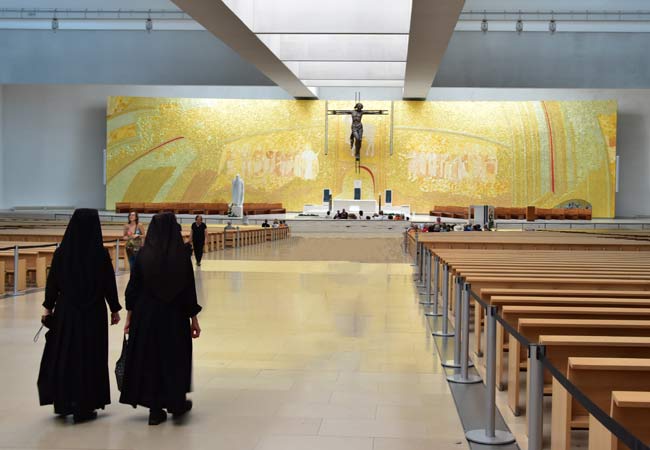
The modern Basílica da Santíssima Trindade was completed in 2007 and has seating for 8,633
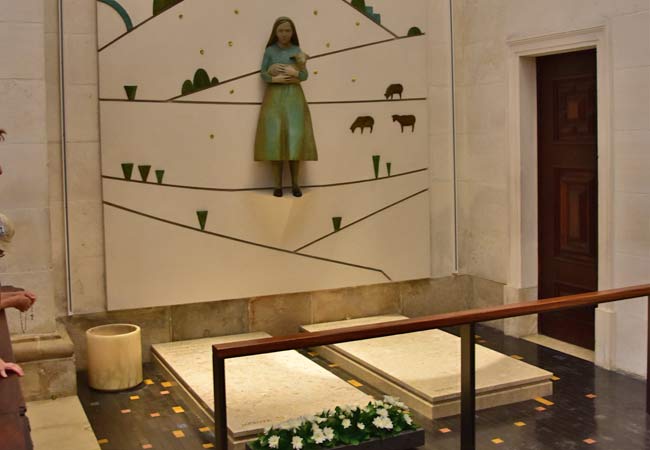
The tombs of Lúcia and Jacinta in the Basílica de Nossa Senhora do Rosário
Have You Considered a Small Group Tour to Fatima?
An organised tour is an excellent way to experience Fátima, particularly for first-time visitors or those without a car. Tours also offer a practical advantage: they pack multiple destinations into a single day while removing the hassle of navigating public transport. The following tours to Fátima come highly recommended:
• Fátima region tour from Lisbon
• A popular small group tour of Fatima, Obidos and Nazaré from Lisbon
• Fátima and Coimbra full-day tour from Porto
Important days at Fatima
The main pilgrimage days at Fátima align with the dates of the six apparitions, which all occurred on the 13th of each month, from 13th May 1917 (the first vision) through to the Miracle of the Sun on 13th October 1917.
The 13th of May and 13th of October remain the most significant pilgrimage days (known as the Peregrinação de Fátima), drawing vast crowds from across Portugal and beyond. On the preceding evenings (the 12th), a candlelit procession led by the bishop and church leaders winds through the sanctuary, creating an unforgettable atmosphere.
Between May and October, candle processions take place most evenings and are well worth attending if your visit coincides. The latest schedule, along with mass times, can be found on the official Shrine of Fátima website: www.
Please Be Respectful
The Santuário de Fátima holds profound spiritual significance for pilgrims, many of whom visit seeking solace during times of illness, loss, or personal hardship. As a place of worship and reflection, visitors are asked to maintain a respectful demeanour, dress modestly, and refrain from treating the site purely as a tourist attraction. Photography should be minimal and discreet, respecting the privacy of those in prayer.
All religions and faiths are welcomed at Fátima.
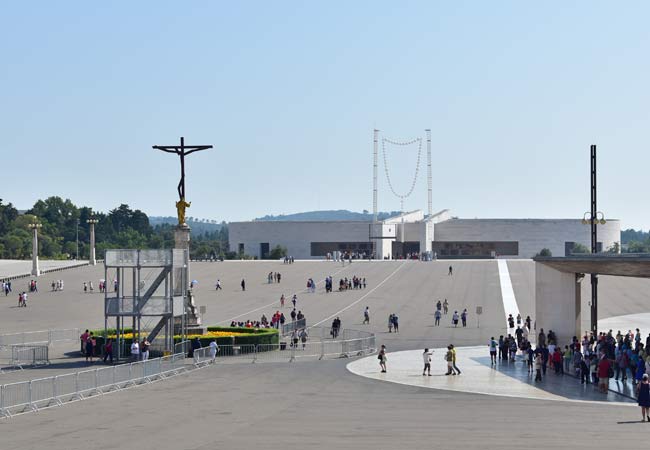
The vast central plaza of the Santuário de Fátima, which can accommodate the many thousands of pilgrims who gather on important feast days.
The Capelinha das Aparições and the Pope’s bullet
The tiny Capelinha das Aparições chapel is the focal point for all devotion at Fátima, its construction said to have been instructed by Mary herself. The exact site of her apparition, just in front of the chapel, is marked by a statue of Our Lady of Fátima. A modern open-sided church now encompasses both the chapel and statue, and this is where masses are held.
Pope John Paul II had a profound connection with Our Lady of Fátima, believing the third secret of Fátima foretold the assassination attempt on his life in 1981 and that she had protected him during it. In an act of devotion, one of the four bullets that struck him is now encased in the crown of the Our Lady of Fátima statue.
Insight: When pilgrims pay homage to Fátima by walking on their knees or crawling across the plaza, they are heading to the Capelinha das Aparições, not the grand Basílica de Nossa Senhora do Rosário.
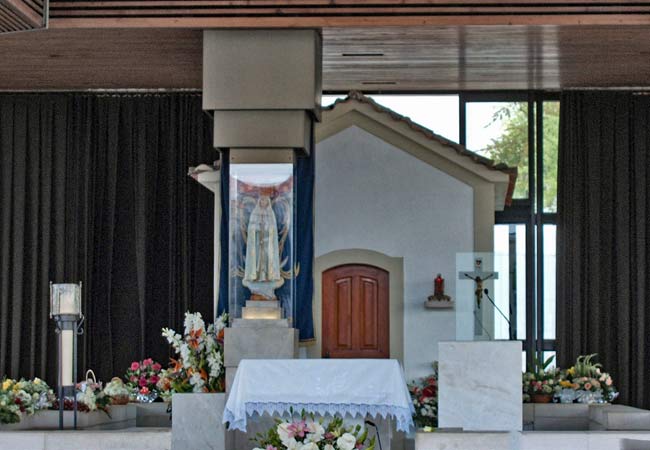
The Capelinha das Aparições chapel with the statue of Mary
The Azinheira Tree
When Mary first appeared to the shepherds in 1917, she appeared beneath an Azinheira tree (holm oak). This blessed but unfortunate tree was soon stripped bare by locals seeking holy relics from its branches and trunk.
The Azinheira tree standing in the Santuário de Fátima today is that same original tree, now over 110 years old and offering a welcome splash of greenery amid the utilitarian plaza.
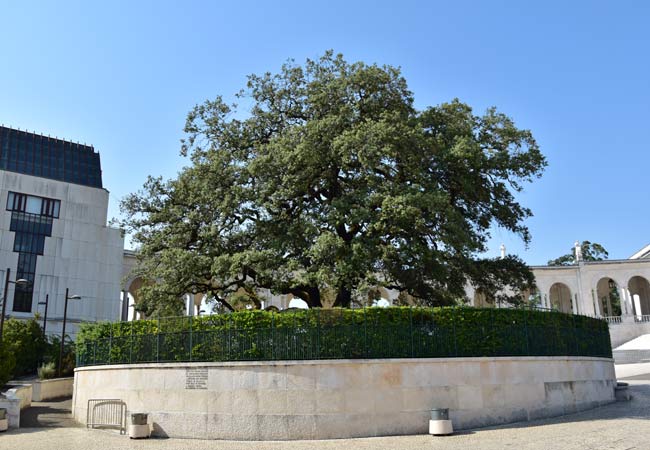
The Azinheira tree adds a touch of greenery to the Santuário de Fátima's plaza
Lighting a Candle at Fatima
One of the spiritual highlights of Fátima is lighting a candle and praying for a special intention at the Capelinha das Aparições.
Candles are available from the stall behind the chapel, with prices ranging from €1 for standard sizes to €4.00 for 60cm devotional candles. The brown colour of these candles comes from their eco-friendly production, using recycled wax from previously burned candles.
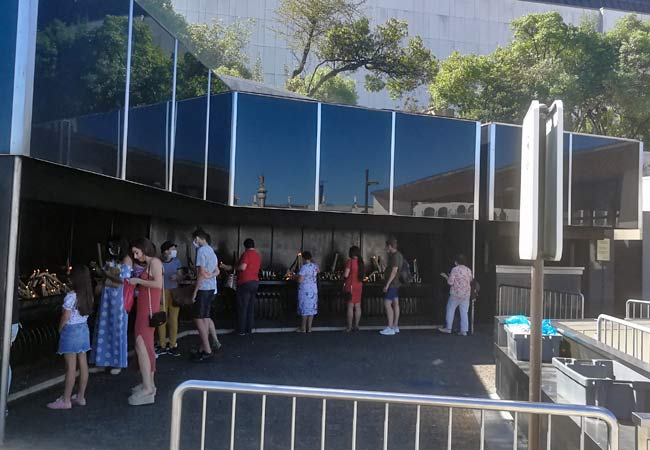
The area where pilgrims light their candles. Due to the sheer number burning at once, significant heat is generated, and many pilgrims simply add their candle directly to the glowing mass of flames.
The shepherd’s houses
Among the most moving sights in Fátima are the modest homes where the shepherd children lived. The two houses (Casa de Jacinta e Francisco Marto and Casa da Lúcia) lie in the village of Aljustrel, 2.2km south of the Santuário de Fátima.
Both have been carefully restored to their 1917 condition, featuring original furniture and period items that offer an authentic glimpse into rural Portuguese life of the early 20th century. The simple stone buildings, with their basic furnishings and humble rooms, bring home just how ordinary the backgrounds of the three young visionaries were.
The Casa da Lúcia includes the family's garden, where visitors can find the Poço do Arneiro well. This well holds special significance: it was here that the Angel of Peace (Anjo de Portugal) made his second appearance to the children in 1916, between his first and third appearances at Loca do Cabeço.
Getting there: The houses can be reached on foot by following the Via dos Pastorinhos (Way of the Little Shepherds) from the sanctuary, or by a short drive with parking available nearby.
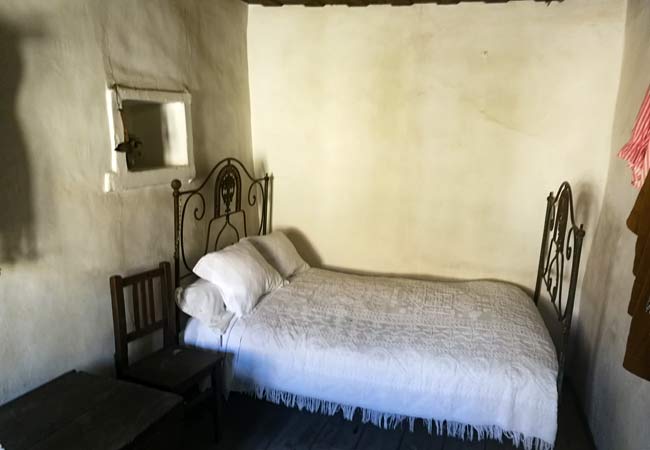
The restored bedroom in the Casa de Jacinta e Francisco Marto
Travel between Lisbon and Fatima
Driving is the quickest way to reach Fátima from Lisbon. The route follows the A1 motorway, turning off at junction 8 after passing through the hills of the Serras de Aire e Candeeiros, from where signs lead to the many car parks surrounding the sanctuary. The 120km journey takes around 1h10m, though the main downside is the toll of €8.40 each way.
For public transport, the bus is the only sensible option. Fátima does have a train station, but it lies 20km east of the town with no practical onward connection to the Santuário de Fátima.
Bus services are operated by Rede Expressos, Portugal's main intercity coach company. Up to 18 departures run daily from Sete Rios bus station in Lisbon, with the journey taking around 1h30m. Ticket prices are dynamic (meaning peak services cost more), but expect to pay around €15 for a single. Popular departures do sell out, so booking in advance is advisable.
Timetables and bookings are available on the Rede Expressos website: www.
Related articles: Lisbon to Fatima - Sete Rios bus station
Frequently Asked Questions
Is it worth visiting Fátima if you are not religious?
Yes. While it is a primary pilgrimage site , cultural visitors can appreciate the immense scale of the sanctuary complex and explore the 20th-century shepherd houses in Aljustrel, which offer a fascinating window into rural Portuguese history.
How long does a typical visit to Fátima take?
A typical visit takes around three hours. This allows enough time to explore the main religious buildings, discover the shepherd houses in the village of Aljustrel, and see the wax museum.
When are the candle processions in Fátima?
Between May and October, candlelit processions take place most evenings. The most significant events occur on the 12th and 13th of each month, commemorating the dates of the 1917 apparitions.
What is the best way to travel from Lisbon to Fátima?
Driving is the fastest option, taking about 1 hour and 10 minutes. For public transport, the bus is the only sensible choice; Rede Expressos operates frequent direct coaches from Lisbon's Sete Rios station, with a journey time of approximately 1 hour and 30 minutes.
Where can you see the houses where the shepherd children lived?
The modest homes of Lúcia, Francisco, and Jacinta are located in the village of Aljustrel, which is 2.2km south of the main Santuário de Fátima complex. These houses have been restored to their 1917 condition with original furnishings.
Discover more of central Portugal with our guides


About this guide: I'm Philip Giddings. I live in Graça, Lisbon, with my Portuguese wife Carla, whose family have been Lisboetas for generations. I've been visiting Portugal since 2001 and writing the independent guides at MyPortugalHoliday.com since 2011, which is now my full-time work. Central Portugal was where Carla and I did much of our early exploring together, and twenty-five years on we still return to the same towns every year: the beaches at Nazaré and Ericeira with family in summer, the walled streets of Óbidos, and the quieter spots inland that most itineraries skip. Carla's extended family are spread across the region, from an aunt near Évora to good friends in Tomar, which gives me firsthand insight and people to check things with on the ground.
This site has 157 guides covering Portugal, from Coimbra down to the southern Alentejo. It takes no payment from tourist boards, tour operators, or attractions for inclusion, and is funded by affiliate commissions on tour bookings, disclosed on every page that contains them. Every practical detail (ticket prices, opening hours, bus and train routes, time-slot policies) is checked against the official sources and verified in person on the trips I make through the region across the year. Read my full story here.
 -
-


If you've found our content valuable, we'd welcome your support.
The digital publishing landscape has evolved significantly. As a small independent publisher, we face growing challenges. Search engines increasingly favour paid content over organic results, while AI-generated content often reproduces original work without attribution.
To support our work, please consider bookmarking this page (press Ctrl + D) for quick access. If you find an article helpful, we'd be grateful if you'd share it with friends on social media.
For specific questions, please see our Reddit community at r/LisbonPortugalTravel.
Should you notice any outdated or incorrect information, please contact us at [email protected]
Thank you for helping us continue to provide valuable content in an increasingly challenging digital environment.