MyPortugalHoliday.com
The best independent guide to Central Portugal
MyPortugalHoliday.com
The best independent guide to Central Portugal
Nazaré, Portugal: Best Sights and Attractions in 2026
Nazaré is a town that lives two completely different lives. For centuries, Nazaré drifted along as a quiet fishing community, its way of life shaped by the Atlantic and the families who worked its waters. Then the surfing world discovered what lies just offshore: a deep underwater canyon that funnels ocean swells into some of the largest waves ever ridden. These days, the town pulls in two very different crowds, each season bringing its own character and appeal.
In summer, the broad golden beach fills with holidaymakers, with evenings spent in one of the many excellent fish restaurants and lively bars. In winter, the mood shifts entirely. Spectators gather on the clifftops, wrapped in coats, to watch professional surfers take on swells that can exceed 30 metres. It is the kind of spectacle that has put Nazaré in the record books, and watching it in person is genuinely stirring.
There is more to the town than sand and surf, though. The historic Sítio district perches on the headland above, home to a grand baroque church and sweeping coastal viewpoints. Down below, the old fishing quarter has kept its traditional character, with narrow cobbled streets leading past seafood restaurants and a municipal market, where the day's catch is laid out on ice by fishermen's wives in their traditional seven-skirted dresses.
I have been exploring Portugal since 2001 and, together with my Portuguese wife, regularly head up to Nazaré. We know the town across all seasons, from the quiet months to the winter spectacle and summer bustle. Drawing on our first-hand experience, this guide walks you through all of Nazaré's main attractions and activities, from the essential sights to lesser-known spots, along with the day trips in the surrounding region worth your time.
One word of caution on those famous waves: the giant swells only appear around 10 to 15 times during the winter season, when specific storm and swell conditions align. It is worth checking forecasts before you travel rather than assuming you will see them.
Overview of the main sights of Nazare
For a town of its size, Nazaré has a surprising amount to see. I have put together the list below to give you a quick sense of what is here, with a map and fuller descriptions further down the page.
The top 10 sights of Nazaré
1. Praia da Nazaré. The town's main beach, a wide crescent of golden sand where you will find sunbathers and swimmers throughout the summer months.
2. São Miguel Arcanjo Fort. A 16th-century coastal fort, now home to a surfing museum and working lighthouse. The terraces provide a front-row view over Praia do Norte and its famous waves.
3. Santuário de Nossa Senhora da Nazaré. A baroque church in the Sítio district, built around a venerated statue of the Virgin Mary and, for centuries, one of Portugal's great pilgrimage sites.
4. Miradouro da Pederneira. A viewpoint beside the old Pederneira district, with wide views over the town and coastline. I would recommend timing your visit for sunset.
5. Ermida da Memória. A small clifftop chapel lined with azulejo tiles, marking the spot of a medieval miracle you will read more about further down the page.
6. Monte de São Bartolomeu. A 156-metre hill within the Leiria pine forest. A steep staircase takes you to the summit, where the panoramic view stretches the length of the bay.
7. Mercado Municipal da Nazaré. The town's covered market. I would encourage you to take a look inside, even if you are not shopping, for the fresh fish counters and regional produce.
8. Praia do Norte. The wild, exposed beach north of the headland, and the setting for Nazaré's big-wave surfing in winter.
9. Avenida da República. The seafront promenade running the length of the main beach, lined with cafés and restaurants.
10. Ascensor da Nazaré. A historic funicular railway linking the beach area to the clifftop Sítio district. A characterful way up, and a welcome alternative to the climb.
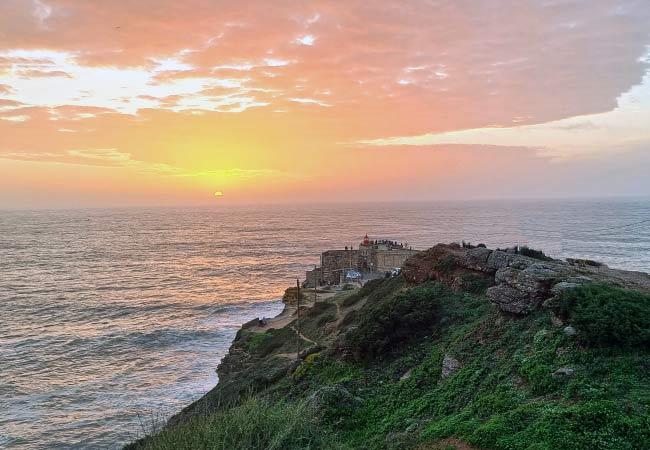
Sunset over the São Miguel Arcanjo Fort
Other notable sights in Nazaré
11. O Sítio district. The historic clifftop neighbourhood above the main town, with cobbled streets, traditional houses, and the best of the headland viewpoints.
12. Marina da Nazaré / Porto da Nazaré. The town's sheltered harbour, home to both a modern marina and the working fishing fleet.
13. Barcos Salva Vidas. Traditional wooden lifeboats displayed along the beachfront, a reminder of the risks Nazaré's fishermen once faced.
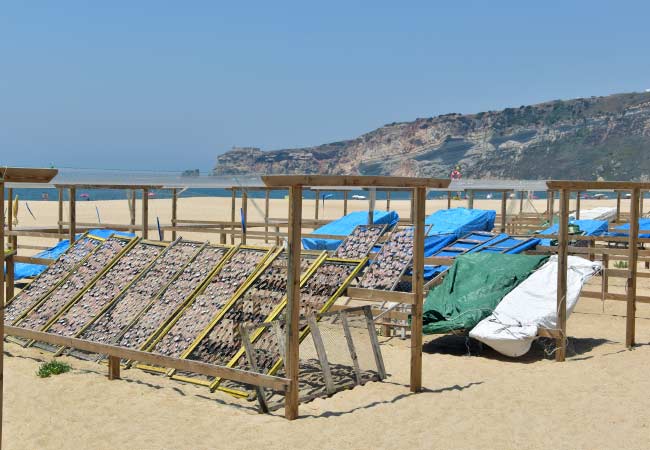
14. Seca do Peixe (Fish Drying Area). An open-air area where fish are still dried in the sun using traditional methods. One of the few places in Portugal where you can still see this practice.
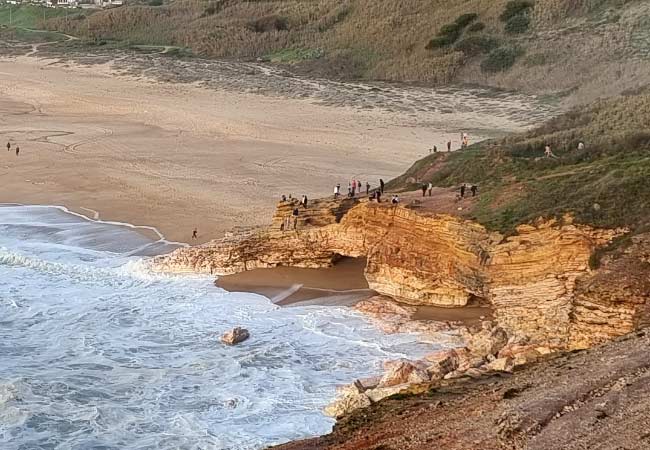
15. Gruta Forno de Orca. A sea cave at the base of the headland with a large natural opening in its roof, accessible only at low tide. The name translates as "Whale Oven Cave".
16. Praia do Sul. A quieter beach south of the harbour. If the main stretch feels too busy, this is where I would direct you for a more peaceful beach trip.
17. Nazaré Canyon. The underwater canyon responsible for the giant waves. At 230 kilometres long and up to 5,000 metres deep, it is the largest submarine canyon in Europe.
18. Miradouro do Suberco. A clifftop viewpoint in Sítio looking straight down over the main beach and town.
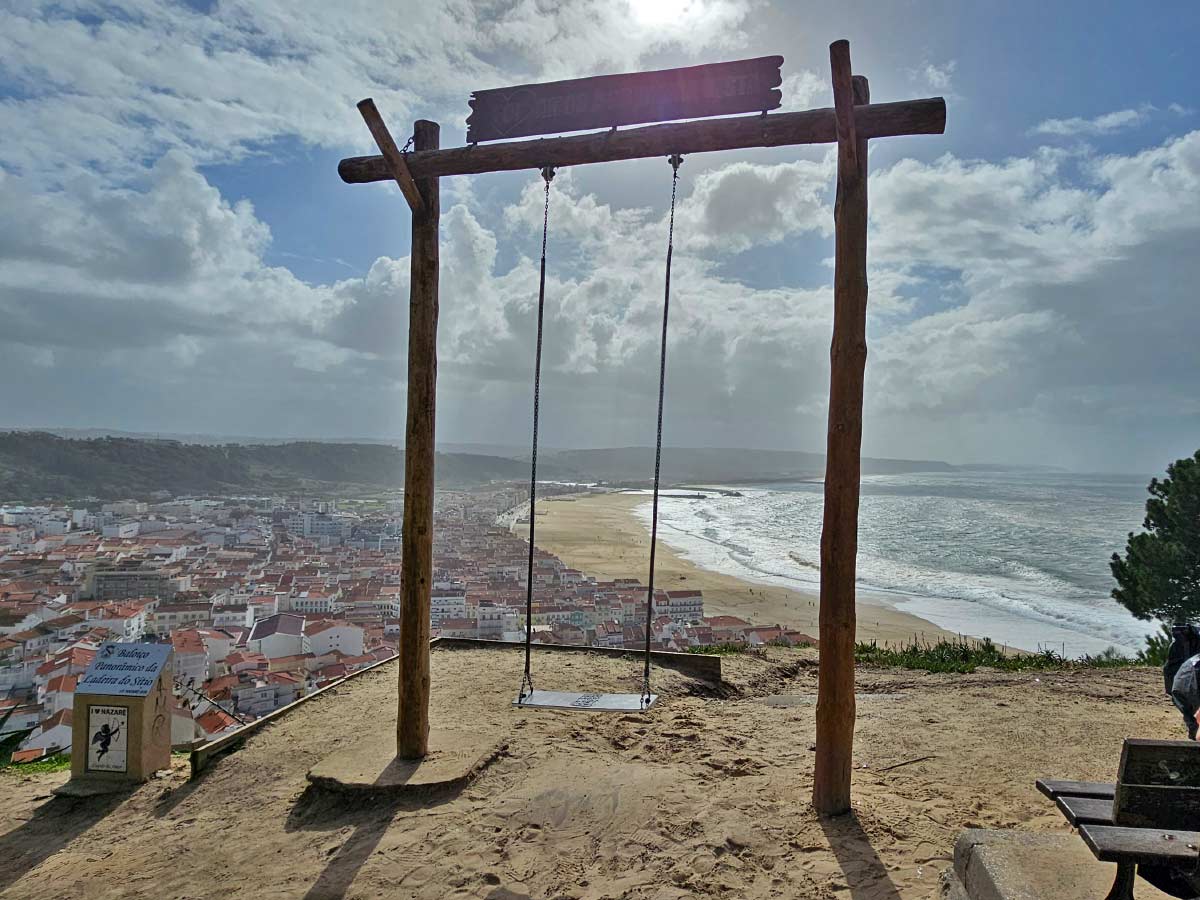
19. Baloiço da Ladeira. A swing set at a scenic viewpoint, popular for photographs. I would save this one for a clear day, when the light is at its best.
20. Escultura Veado Surfista. A sculpture of a deer on a surfboard, tying together the medieval legend of Dom Fuas Roupinho (who nearly rode his horse off the cliff chasing a deer) with the town's modern surfing identity.
21. Fishing quarter. The old part of town near the beach, with narrow streets, traditional shops, and some of the best seafood restaurants you will find in Nazaré.
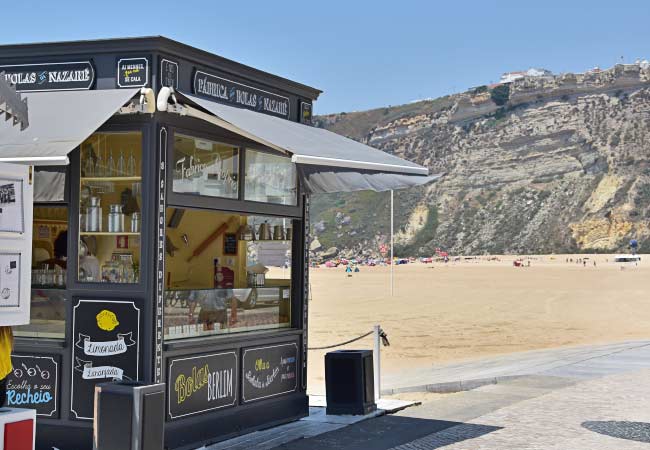
22. Bolo de Berlim. A custard-filled doughnut sold from stalls along the beach. Eating one is an unofficial Nazaré tradition, and I would encourage you to join in.
The best of the Nazaré region
Nazaré sits within easy reach of some of central Portugal's best attractions. To the south, you will find quieter beaches and sheltered bays, while inland I would point you towards monasteries and extensive cave systems. Every one of the places below can be visited as a half-day or day trip from Nazaré.
Mira de Aire Caves (40 km). Portugal's largest publicly accessible cave system, with stalactites, stalagmites, and an underground lake. Guided tours take you 110 metres below ground, and I would rate it among the most memorable half-days in the region.
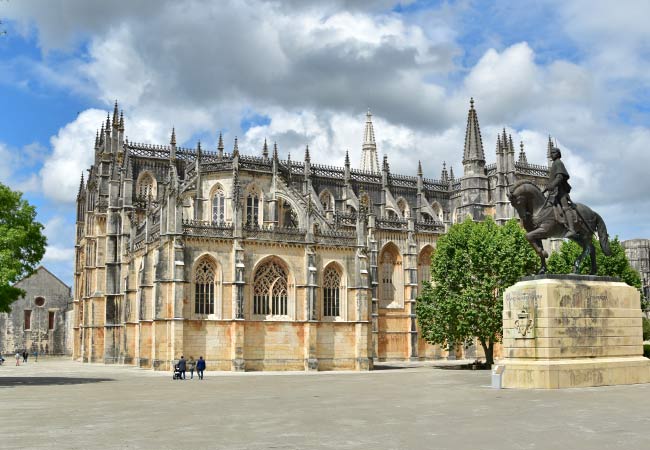
Mosteiro da Batalha (35 km). A UNESCO World Heritage Site built to commemorate Portugal's 1385 victory over Castile. The Gothic and Manueline stonework is extraordinary, and several Portuguese kings are buried here.
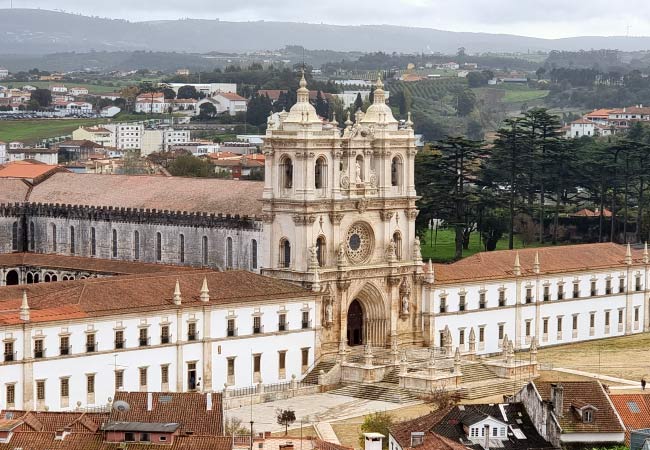
Mosteiro de Alcobaça (15 km). A vast Gothic monastery founded in the 12th century, best known for the ornate tombs of King Pedro I and Inês de Castro, whose tragic love story is woven into Portuguese folklore.
Mosteiro de Santa Maria de Coz (12 km). A lesser-known former Cistercian convent, where a 17th-century church showcases baroque decoration and traditional tilework. If you prefer your monasteries without the coach tours, this is the one I would send you to.
Grutas de Santo António (47 km). Another limestone cave system, smaller than Mira de Aire but with colourful rock formations and noticeably fewer visitors.
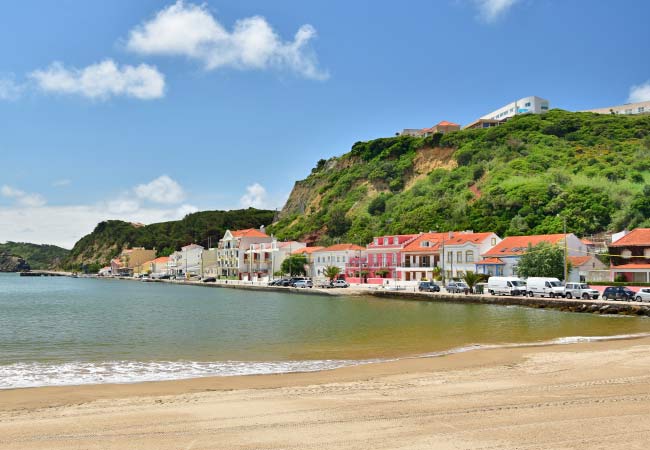
São Martinho do Porto (9 km). A small resort town built around an almost enclosed bay, where the water is calm and shallow. I would recommend it to families travelling with young children, or to anyone wanting a gentler swim than the open Atlantic allows.
The following map shows the location of all these sights. Note: zoom out to see the sights of the region.
Legend: 1) Praia da Nazaré 2) São Miguel Arcanjo Fort 3) Santuário de Nossa Senhora da Nazaré 4) Miradouro da Pederneira 5) Ermida da Memória 6) Monte de São Bartolomeu 7) Mercado Municipal 8) Praia do Norte 9) venida da República 10) Ascensor da Nazaré 11) O Sítio district 12) Marina da Nazaré 13) Barcos Salva Vidas 14) Seca do Peixe 15) Gruta Forno de Orca 16) Praia do Sul 17) Nazaré Canyon 18) Miradouro do Suberco 19) Baloiço da Ladeira (swing) 20) Escultura Veado Surfista 21) Fishing quarter 22) Bolo de Berlim stall
Sights of the region (blue) 23) Mira de Aire Caves 24) Mosteiro da Batalha 25) Mosteiro de Alcobaça 26) Mosteiro de Santa Maria de Coz 27) Grutas de Santo António 28) São Martinho do Porto
Sights of Nazare
São Miguel Arcanjo Fort
The São Miguel Arcanjo Fort stands at the far edge of the Sítio headland, and I would put it near the top of your list for the view alone. It looks directly down onto Praia do Norte, the beach responsible for Nazaré's reputation as a big-wave capital. Originally constructed in 1577 to defend the fishing village from Algerian, Moroccan and Norman pirates, the fortress was expanded in 1644, when an image of the archangel Michael was sculpted above the entrance. Its function has shifted over the centuries, and a lighthouse was added in 1903 to help ships navigate the dangerous Atlantic waters. It is still operational today.
The fort also witnessed occupation by Napoleon's troops in 1807. Local residents and a group of students famously drove out the French invaders, and the site became a symbol of popular resistance.
Inside, a small museum documents the area's surfing heritage and maritime history. The Surfer Wall features boards donated by world-record holders, and I would not rush through it, as the names and dates on each board tell you a lot about how quickly Nazaré has built its modern reputation.
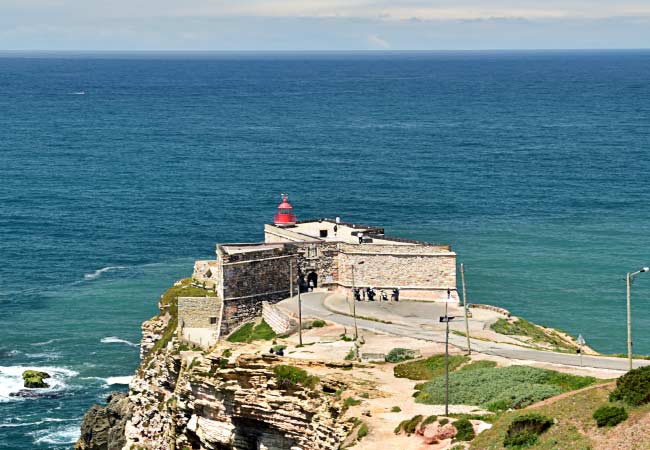
The São Miguel Arcanjo fort on a calm summer's day
A word of warning, though: it is always windy up here. On a summer's day that breeze is welcome, but in winter, when the big swells are running and everyone crowds onto the headland to watch. I have stood out there shivering, with spray from the waves reaching the clifftop watching the surfer. If you are visiting in big-wave season, wear considerably more than you think you will need.
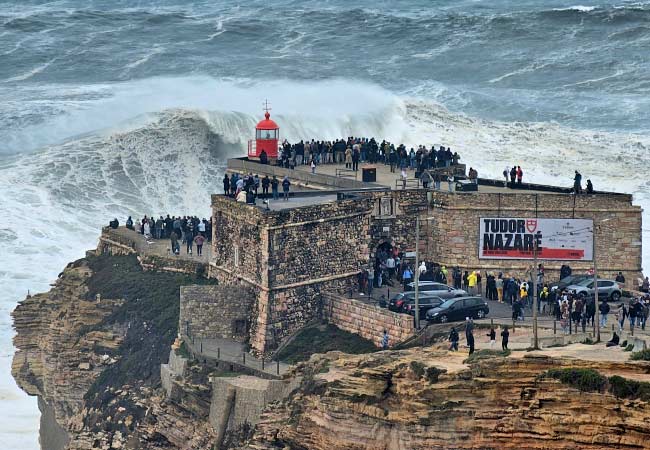
During big-wave season, it becomes a focal point for watching the daredevil surfers below.
Santuário de Nossa Senhora da Nazaré
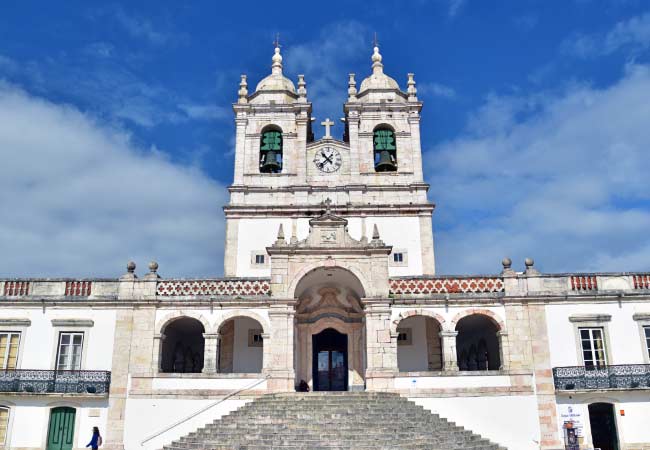
The Santuário de Nossa Senhora da Nazaré has dominated the Sítio district since the 14th century and remains the most significant religious landmark in the town. It was built to house a sacred, dark wooden statue of the Virgin Mary, known as the Black Madonna. The figure is believed to have been carved by Saint Joseph and brought to the region in the 4th century. Over the centuries, the sanctuary has attracted high-profile figures, including the explorer Vasco da Gama and King Dom João I, who funded a major reconstruction of the site in 1377.
Inside, you will find a space filled with ornate gilded woodwork and religious artefacts that reflect centuries of devotion. The interior is particularly noted for its extensive tilework, featuring thousands of Dutch azulejos by Willem van der Kloet. For generations, the sanctuary has been one of Portugal's great pilgrimage destinations, and it remains a central part of local identity. You will see this in the numerous offerings left by sailors who survived the dangers of the Atlantic, displayed around the interior.
Ermida da Memória
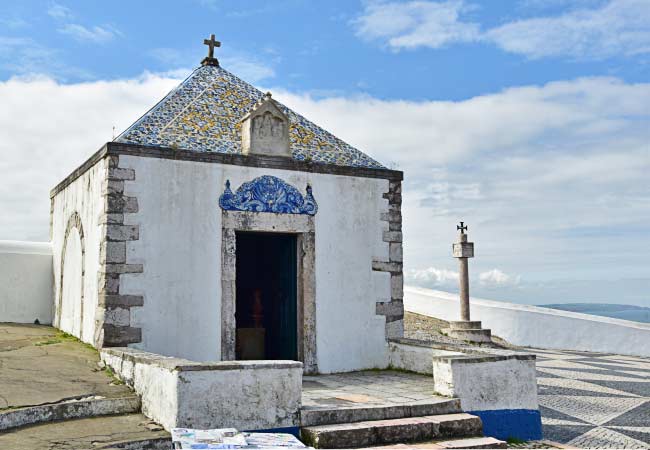
The Ermida da Memória is a small, square chapel perched on the edge of the Sítio cliffs, marking the site of a legendary medieval miracle. Founded in the 14th century, it commemorates the story of the nobleman Dom Fuas Roupinho, who was saved from a fatal fall in 1182. According to local tradition, Roupinho was hunting a deer in heavy fog when his horse nearly galloped straight over the precipice.
After he invoked the protection of the Virgin Mary, the horse stopped instantly at the cliff's edge, saving his life. The interior of this modest building is decorated with traditional blue and white azulejo tiles depicting the miraculous event. Despite its small size, the chapel holds great importance in Nazaré's history, and is well worth a few minutes of your time while you are exploring the headland.
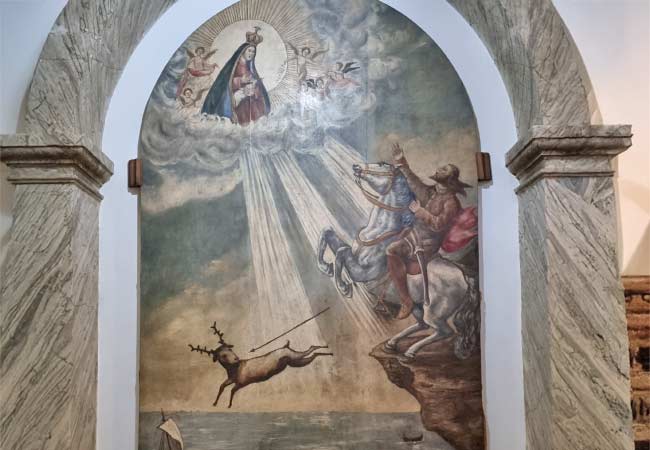
The legend of Dom Fuas Roupinho halting before he fell off the cliffs above Nazare
Escultura Veado Surfista
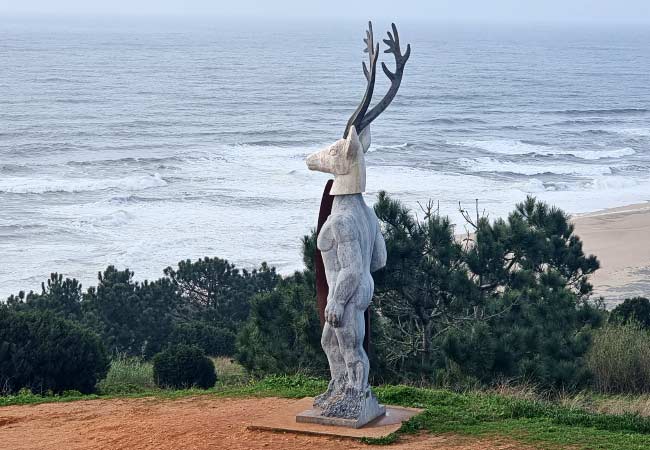
You will pass the Escultura Veado Surfista on the blustery walk down to the São Miguel Arcanjo Fort, and at first glance it is an odd-looking thing, a deer-headed figure clutching a surfboard. Look again, though, and it is rather more clever than the usual roadside photo op. This bronze sculpture ties together two threads of Nazaré's identity that are separated by eight centuries.
The deer is a direct reference to the miracle of Dom Fuas Roupinho in 1182, the story you will have already read about at the Ermida da Memória just up the path. By placing that same legendary animal on a modern surfboard, the sculptor makes a quiet point: the very cliffs that nearly sent Roupinho and his horse to their deaths are now the stage on which professional surfers tackle the biggest waves in the world. Ancient folklore and modern record-breaking, standing on the same headland. I would stop for a moment, even if you do not take a photograph.
Mercado Municipal da Nazaré
Nazaré may be known for its beach and its surfing, but I have always had a soft spot for the more traditional side of the town, and there is no better place to see it than the Mercado Municipal. Step inside and the senses take over: the overpowering smell of fresh fish, the noisy bartering between stallholders and restaurateurs, the locals angling for the finest cuts before they are gone. It is the working heart of the town, and it has not been polished up for visitors.
The market sits in the heart of the lower town on Avenida Vieira Guimarães, and the covered building was constructed in 1955 to give the vendors a permanent home. Today, it functions as a central hub for regional specialities. Each morning, fishmongers display the daily catch from the Atlantic, and you will often see women working the stalls in the traditional seven skirts, a local custom rooted in the town's maritime history. Even if you are not buying, I would encourage you to walk through.

Ascensor da Nazaré
The Ascensor da Nazaré is a funicular railway that has connected the beach area with the clifftop Sítio district since it opened in 1889, and it remains one of the oldest operating funicular systems on the Iberian Peninsula. It was designed by Raoul Mesnier du Ponsard, a protégé of Gustave Eiffel and the engineer responsible for Lisbon's Santa Justa Lift, so the pedigree is considerable for what looks, from the outside, like a modest piece of local transport.
The cars climb a steep 110-metre incline over a track distance of 318 metres, negotiating an unusual curve during the three-minute journey. It was originally powered by a hydraulic water-ballast system, though the mechanism was modernised with an electric motor in 1963.
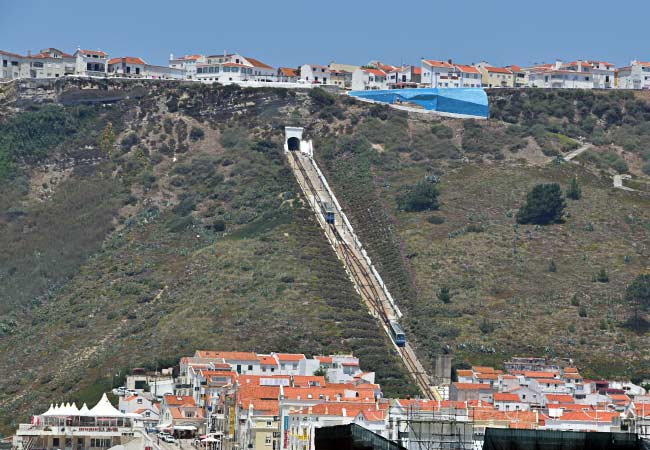
Barcos Salva Vidas
The Barcos Salva Vidas are traditional wooden lifeboats, permanently displayed on the sand along the main beach as a reminder of the rescue missions once carried out by local volunteers. Each vessel, such as the Nossa Senhora dos Aflitos or the Mimosa, has a distinct design optimised for launching directly into heavy Atlantic swells from the shoreline. Painted in bright traditional colours, they were the primary means of saving fishermen from dangerous currents and shifting tides before modern motorised technology became available.

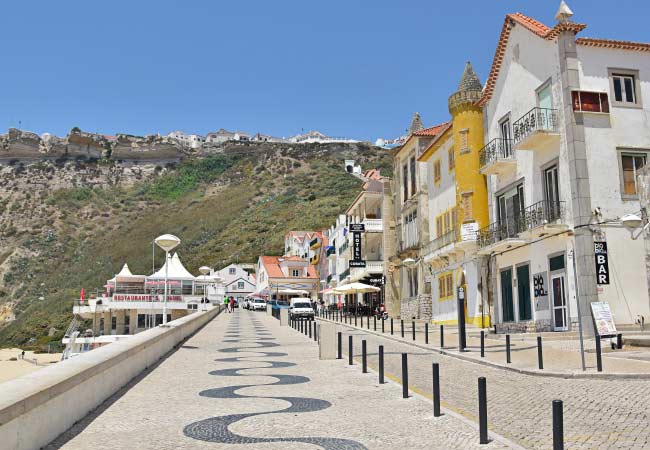
Praia da Nazaré and Avenida da República
The town's main beach is a wide crescent of golden sand that defines the coastline of the lower town. During the summer, the waters here are calm and suitable for swimming, a sharp contrast to the violent swells on the northern side of the headland. Running its entire length is the Avenida da República, a broad seafront promenade lined with cafés and restaurants.
This is where I would send you for a stroll on a warm summer afternoon, ice cream in hand, watching the beach and town come alive with a mix of Portuguese holidaymakers and foreign visitors. My own preferred spot is the quieter southern end of the promenade, where I tend to start the day with a morning coffee before the main stretch fills up. It is a simple pleasure, but one of the things I look forward to most whenever we head up from Lisbon.
Nazaré Canyon
The Nazaré Canyon is the massive underwater feature that acts as the primary engine for the town's famous waves. As the largest submarine canyon in Europe, it stretches 230 kilometres across the ocean floor and reaches depths of 5,000 metres. Because the head of the canyon sits just offshore, it funnels and amplifies Atlantic swells directly towards Praia do Norte. The interactive model at the São Miguel Arcanjo Fort helps make sense of how all this works, and I would suggest a few minutes with it before you head out to the viewpoint.
The geology does something unusual with the water. As swells enter the canyon, they refract, splitting the wave energy so that it travels at different speeds. When those separate wave fronts collide over the shallow sandbanks closer to shore, they stack into a "wedge" that can exceed 30 metres during winter storms. A coastal current pushing against the incoming swells adds further energy to the mix. These conditions occur roughly 10 to 15 times between autumn and spring, and they are what has drawn the professional surfers who have set multiple world records at this exact spot.

A word of warning on timing your visit. If you are coming to Nazaré specifically to see the giant waves, you will need to be prepared for disappointment. The conditions are narrow, and there is no way to predict them more than a few days out. I would strongly advise against booking a fixed day trip from Lisbon and hoping that you happen to catch a big swell. You are far more likely to spend the day looking at a grey, choppy sea than anything record-breaking.
Flexibility is what you need. I spent a full week in Nazaré in November 2024 specifically to see the waves, and in the end only one day delivered. The other six were spent looking out of the hotel window at wet, miserable weather and a sea that was doing nothing unusual. If you can build in a week, and are willing to move around your plans at short notice when the forecasts come in, your chances improve considerably. If you only have a day, I would treat any big waves you see as a bonus rather than the reason for the trip.
Gruta Forno de Orca
The Gruta Forno de Orca is a natural limestone cave at the northern base of the Sítio headland, looking out towards the big-wave surf break at Praia do Norte. Its name translates as "Whale Oven Cave," a reference to both its rounded, oven-like shape and the historical reports of whale bones found within the chamber. The cave forms part of a Jurassic limestone formation and features a large, circular opening in its roof. Local fishermen once used it as a barometer for sea conditions, watching the way water moved through the entrance to judge whether it was safe to head out.
Bolo de Berlim
Forget ice creams on the beach. The Portuguese prefer a Bolo de Berlim, and after years of eating them, I have to say I agree. It is a fried, sugar-dusted pastry that is a central part of the seaside experience in Nazaré, and once you have had one, the idea of a beach trip without one feels faintly wrong.
The bolo is a variation of the German Berliner, brought to Portugal by German Jewish refugees during the 1930s and the Second World War. The Portuguese version differs from the original by replacing fruit jam with a rich, yellow egg-based custard known as creme de pasteleiro, a choice influenced by the country's historical convent baking traditions, which used egg yolks in enormous quantities.
You will find permanent kiosks near the promenade, but the bolos are famously sold by mobile vendors who walk the sand carrying heavy coolers, announcing their arrival with a rhythmic shout of "Olha a bolinha!" It is one of the iconic sounds of the Portuguese summer, and on a hot afternoon it is hard to resist.
Monte de São Bartolomeu
I enjoy hiking and escaping the crowds when I can, and Monte de São Bartolomeu is my favourite walk in the region. It is a 156-metre rocky outcrop set within the Leiria pine forest, offering a perspective away from the coastline that most visitors never see. A steep staircase leads to the summit, where you will find a small chapel and a panoramic viewpoint. Allow around 20 minutes for the climb, and take water with you, as there is no shade on the final stretch.
From the top, the entire Nazaré region opens up beneath you: the curve of the bay, the Sítio headland, and the vast Atlantic horizon stretching west. It is a quiet alternative to the busier viewpoints in the town centre, and on most visits I have had the summit largely to myself.
Seca do Peixe (Fish Drying Area)
At the southern end of the main beach, laid out directly on the sand, you will find one of the few places in Portugal where the traditional sun-drying of fish is still practised. It functions as an open-air museum of sorts, though it is very much a working operation. You will see wooden racks, known as estendais, where species like horse mackerel and octopus are cleaned, salted, and left to cure in the Atlantic breeze.
The smell is strong but not unpleasant, and I would say it is part of the experience rather than something to be avoided. The women who manage the drying area often wear the traditional seven skirts of Nazaré, historical attire designed to keep them warm and mobile while they waited for the fishing fleet to return.
Around Nazare
Mira de Aire Caves
Discovered by chance in 1947 when a group of locals, the Grutas de Mira de Aire are Portugal's largest known cave system. A staggering 11 kilometres of tunnels carved out over roughly 150 million years. They opened to the public in 1974, and today they're counted among Portugal's seven natural wonders, which I'd say is well-deserved once you've seen them.
Only 600 metres of the network are accessible, but honestly, that's more than enough. You descend 110 metres below the surface, around 680 steps in total, winding past limestone formations your guide will point out by name: the "Jellyfish," the "Martian," and the rather magnificent "Organ." The colour-lit stalactites and stalagmites look almost theatrical, and when you reach the "Great Lake" at the end, fed by an underground waterfall known as the "Black River," there's a light and sound show that somehow manages to feel magical rather than kitsch.
Mosteiro de Alcobaça
This UNESCO World Heritage Site was the first fully Gothic building in Portugal, founded in 1153 by King Afonso Henriques, and walking into the church is genuinely humbling. The scale is immense, yet the architectural simplicity feels almost austere, which only makes the ornate tombs of King Pedro I and Inês de Castro more striking when you find them. They're placed foot-to-foot so that, according to the legend of their tragic love, the pair will see each other the moment they rise on Judgement Day.
Don't miss the 18th-century kitchen, either. It has a chimney 28 metres tall, and a diverted branch of the Alcoa River once flowed directly through the room, giving the monks a constant supply of fresh water straight from the hills. It's wonderfully eccentric, and a reminder that even monastic life had its creature comforts.
Mosteiro de Santa Maria de Coz
If you're looking for somewhere that feels wonderfully off the beaten track, this is it. Once one of the wealthiest Cistercian nunneries in Europe, Santa Maria de Coz began life as a small hermitage before growing into a powerful institution for women, and stepping inside today, you can still sense that quiet, enduring presence.
The church interior genuinely took my breath away. Gilded woodcarvings catch the light in every corner, and the walls are lined with blue and white tilework in the Portuguese Baroque style, telling stories in ceramic across every available surface. Look out for the 106 hand-carved choir stalls where the nuns once gathered for daily prayer, each one slightly different if you examine them closely.
What I love most is how peaceful it is. While tour buses descend on Alcobaça and Batalha, here you're often left almost entirely alone with the building, which feels like a small privilege. Do check opening hours before you set off, as access can be limited outside peak season, and it would be a real shame to drive out and find the doors closed.
Mosteiro da Batalha
The Mosteiro da Batalha is the sort of building that makes you go quiet for a moment when it first comes into view. A UNESCO World Heritage Site, it was commissioned by King João I to fulfil a vow made after the Portuguese victory over Castile at the Battle of Aljubarrota in 1385. Construction rumbled on for over a century, and as a result the building reads like a record of shifting architectural styles, moving from High Gothic through to the wonderfully ornate Manueline period.
The Founder's Chapel holds the joint tomb of King João and his English wife, Philippa of Lancaster, the first of its kind in Portugal. There is something quietly moving about seeing the pair laid to rest side by side after all these centuries.
The Chapter House is equally striking, with a vast vaulted ceiling that soars above the Tomb of the Unknown Soldier. An eternal flame burns in honour of those lost in the First World War, and the space has a weight to it that is hard to describe.
My favourite part of the monastery, though, is the Unfinished Chapels. This vast octagonal structure remains open to the sky, construction having been halted in the 15th century when resources were diverted to Lisbon's Jerónimos Monastery. Standing inside, with clouds drifting overhead through the place where a roof was meant to be, is the kind of thing you do not forget.
Related articles: Guide to Batalha
São Martinho do Porto
Just 9 kilometres south of Nazaré, you'll find São Martinho do Porto, a town wrapped around one of the most extraordinary bays I've ever seen. Picture a near-perfect shell shape, almost entirely enclosed, with only a narrow opening between two granite headlands letting the Atlantic slip through. Those headlands block the swells, so the water inside is calm, shallow and glassy, gently lapping at your ankles rather than knocking you sideways. It's a gift if you're travelling with small children, or if you fancy a swim without the battering.
The easy holiday feel belies a long past. Back in the 13th century, this was a strategic port, busy with shipbuilding and trade.
Head straight for the main beach, where you've got 3 kilometres of soft golden sand to choose from, and parking is far easier than in Nazaré in summer. Before or after your swim, climb up into the older part of town. Narrow streets wind between whitewashed houses that were here long before the 20th-century waterfront, and on a quiet morning, with shutters still closed, it feels as though the town is letting you in on a secret.
Discover the best of Nazaré and Central Portugal with our guides


About this guide: I'm Philip Giddings. I live in Graça, Lisbon, with my Portuguese wife Carla, whose family have been Lisboetas for generations. I've been visiting Portugal since 2001 and writing the independent guides at MyPortugalHoliday.com since 2011, which is now my full-time work. Central Portugal was where Carla and I did much of our early exploring together, and twenty-five years on we still return to the same towns every year: the beaches at Nazaré and Ericeira with family in summer, the walled streets of Óbidos, and the quieter spots inland that most itineraries skip. Carla's extended family are spread across the region, from an aunt near Évora to good friends in Tomar, which gives me firsthand insight and people to check things with on the ground.
This site has 157 guides covering Portugal, from Coimbra down to the southern Alentejo. It takes no payment from tourist boards, tour operators, or attractions for inclusion, and is funded by affiliate commissions on tour bookings, disclosed on every page that contains them. Every practical detail (ticket prices, opening hours, bus and train routes, time-slot policies) is checked against the official sources and verified in person on the trips I make through the region across the year. Read my full story here.