MyPortugalHoliday.com
The best independent guide to Central Portugal
MyPortugalHoliday.com
The best independent guide to Central Portugal
Why does Nazaré have the biggest waves in the world?
Nazaré was once a quiet fishing village, but it is now known globally for hosting the largest surfable waves on the planet. Whilst most beaches rely on simple wind and tide, the peaks at Praia do Norte are the result of a rare geological feature located miles beneath the surface.
The Nazaré Canyon
The primary reason for these massive swells is the Nazaré Canyon, a colossal underwater gorge that ranks as the largest in Europe. It begins deep in the Atlantic and stretches 230 kilometres across the sea floor, reaching depths of 5,000 metres. Most coastal areas have a gradually sloping continental shelf that slows waves down through friction as they approach land. The Nazaré Canyon, however, creates a deep-water conduit that leads directly to the shore: a highway that allows swell energy to travel without losing any power to the ocean floor.
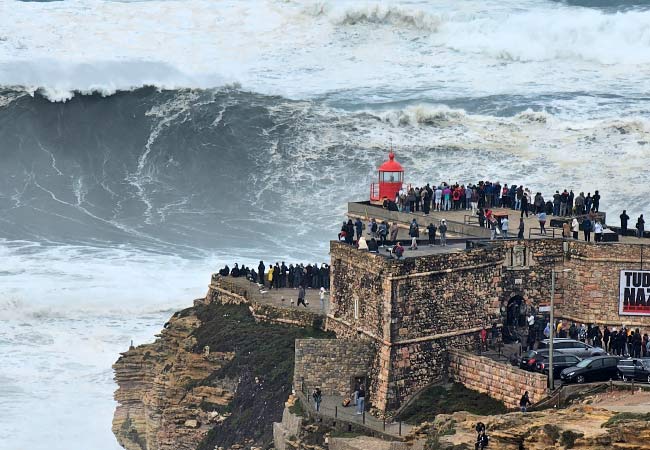
Because the canyon is so deep, it allows the swell to maintain its open-ocean speed and power until it reaches the head of the canyon, just a few hundred metres off the coast by the lighthouse. Here, the sudden change in depth causes the water to thrust upward with incredible velocity.
How the Waves Stack
As these swells approach the beach, the canyon's structure forces the water to behave in a very specific way. The portion of the wave travelling over the deep canyon moves much faster than the parts travelling over the shallower continental shelf on either side. This creates a process called refraction, where the wave essentially bends inward, focusing all its energy toward a single point.
When these two wave fronts meet at the shallow sandbanks near the shore, they collide and stack on top of each other through constructive interference. Rather than passing through one another, they merge to create a wedge: a single peak that can reach heights of 30 metres or more. A local coastal current that pushes back against incoming swells forces the water to rise even more vertically.
The Role of the Coastline
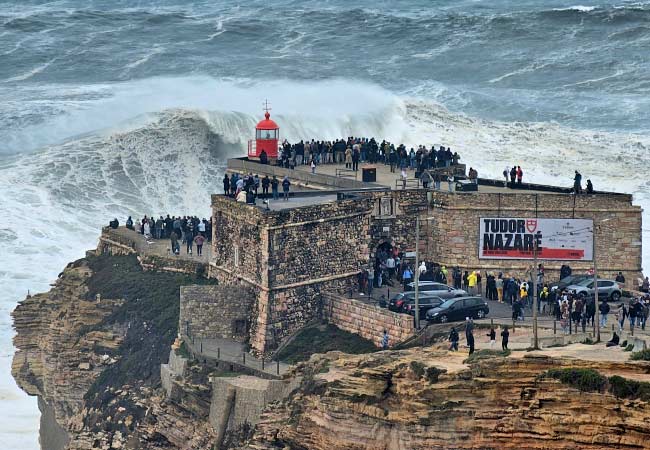
The geography above the water is just as important as the canyon below. The high rocky promontory where the Fort of São Miguel Arcanjo sits acts as a solid wall. When waves hit this cliff, a significant amount of water reflects back toward the ocean. This outgoing backwash hits the next incoming wave like a ramp, launching the crest higher into the air. This interaction gives the waves their jagged, mountain-like appearance: the backdrop for multiple world records.

Planning Your Visit
If you are travelling to Nazaré specifically to witness this force of nature, timing is everything. The giant waves occur only 10 to 15 times during the winter season, typically between October and March, when specific North Atlantic storm conditions align with the canyon's orientation.
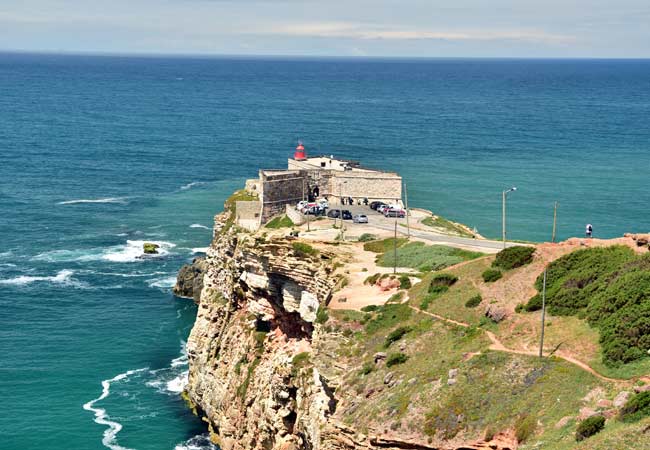
Visitors should be aware that the summer months offer calm, swimmable water rather than the mountainous swells seen in viral videos. The transformation is total: the same spot that produces 24-metre peaks in January becomes a peaceful blue expanse in July. For those hoping to see the giants, it is best to monitor specialised surf forecasts and be ready to travel on short notice when a major swell is predicted.
For those lucky enough to witness a big wave event, the experience is as much about feeling the vibration in the ground as it is about seeing the water. The sheer volume of moving ocean creates a thundering sound that captures the raw power of the Atlantic.
The Surfers Who Made Nazaré Famous
For centuries, the giant waves of Praia do Norte crashed against the cliffs with no one watching. Local fishermen knew the sea was dangerous, but the idea that anyone would willingly ride these monsters was unthinkable. That changed in 2010 when an email from a small Portuguese town reached a surfer in Hawaii, altering the course of big wave history.
Garrett McNamara: The Pioneer
In 2005, Dino Casimiro, a Portuguese bodyboarder from Nazaré, sent a photo of the giant waves to American surfer Garrett McNamara. Casimiro thought McNamara might be interested in visiting Nazaré and scoping out the wave, hoping that if he rode it and survived, Nazaré might find itself on the map with a tourist industry.
McNamara first surfed the waters off Nazaré in 2010, and in November 2011, he entered the Guinness World Records by catching a 24-metre wave at Praia do Norte, after being towed into the wave from a jet ski. The image of McNamara descending that mountain of water was published worldwide, transforming both his career and the sleepy fishing village forever.
Two years earlier there was scarcely one person standing on the cliff near the lighthouse, and soon there were thousands. McNamara became a national hero in Portugal and received the Vasco da Gama Medal of Honour from the Portuguese Navy for his contribution to the country: the only foreigner ever to receive this honour. He married his wife Nicole at the lighthouse overlooking Praia do Norte and now calls Nazaré home. His journey is documented in the HBO series 100 Foot Wave, which has won multiple Emmy awards and brought the sport to mainstream audiences worldwide.
The Record Breakers
After McNamara's breakthrough, a new generation of surfers descended on Nazaré to chase even bigger waves.
On 8 November 2017, Brazilian surfer Rodrigo Koxa broke McNamara's record by riding a 25-metre wave. The wave catapulted Koxa's name from relative obscurity into the mainstream. In 2014, Koxa had almost died at Nazaré and spent months recovering psychologically before returning.
The current official record holder is German surfer Sebastian Steudtner. In 2020, in Nazaré, he surfed a 26-metre tall wave, the tallest wave ever officially surfed. Steudtner has taken a scientific approach to big wave surfing, partnering with Porsche Engineering to develop advanced surfboard technology and drone measurement systems. In February 2024, he surfed what might be the biggest wave ever measured at 28 metres, though official confirmation is still pending. If ratified, it would surpass his own record and edge closer to the mythical 30-metre barrier.
Maya Gabeira: Breaking Barriers
Brazilian surfer Maya Gabeira became the first professional female surfer to chase the waves at Nazaré, and nearly paid the ultimate price. On 28 October 2013, Gabeira lost consciousness and nearly drowned whilst surfing a massive wave at Praia do Norte. She was saved by her fellow Brazilian big-wave surfer Carlos Burle, but suffered a broken fibula and required back surgery during a long recovery.
Rather than retreating, Gabeira relocated from Hawaii to Portugal and made Nazaré her base. In February 2020, she surfed a 22-metre wave, recorded by Guinness World Records as the biggest wave ever surfed by a woman. Her achievement marked the first time in the history of the sport that the biggest wave of the year had been ridden by a woman: her wave was actually larger than the men's winner that season.
The Current Elite
Today, Nazaré attracts the world's best big wave surfers each winter season. Brazilian Lucas Chumbo Chianca holds five wins at the Nazaré Big Wave Challenge, including back-to-back titles for Best Male Performance. The 29-year-old has arguably the best Nazaré resume of any active surfer and is considered by many to be the most dominant competitor at the break.
French surfer Justine Dupont has established herself as the undisputed queen of women's big wave surfing. She holds the record for the second largest wave ever surfed by a woman at 22 metres and is a 12-times World Champion at the XXL Big Wave Awards. Since 2019, she has earned 12 awards for Ride of the Year, Biggest Wave, and Performance of the Year. She won the Nazaré Big Wave Challenge again in December 2025, just under two years after giving birth to her son.
Portuguese surfer Nic von Rupp has become a local hero, winning back-to-back team titles alongside French partner Clement Roseyro. For the surfers who now call Nazaré home, the wave has become more than a proving ground: it is a way of life, drawing athletes from Brazil, France, Germany, the UK, and beyond to this once-quiet fishing village on the Silver Coast.
Discover more of central Portugal with our guides


About this guide: I'm Philip Giddings. I live in Graça, Lisbon, with my Portuguese wife Carla, whose family have been Lisboetas for generations. I've been visiting Portugal since 2001 and writing the independent guides at MyPortugalHoliday.com since 2011, which is now my full-time work. Central Portugal was where Carla and I did much of our early exploring together, and twenty-five years on we still return to the same towns every year: the beaches at Nazaré and Ericeira with family in summer, the walled streets of Óbidos, and the quieter spots inland that most itineraries skip. Carla's extended family are spread across the region, from an aunt near Évora to good friends in Tomar, which gives me firsthand insight and people to check things with on the ground.
This site has 157 guides covering Portugal, from Coimbra down to the southern Alentejo. It takes no payment from tourist boards, tour operators, or attractions for inclusion, and is funded by affiliate commissions on tour bookings, disclosed on every page that contains them. Every practical detail (ticket prices, opening hours, bus and train routes, time-slot policies) is checked against the official sources and verified in person on the trips I make through the region across the year. Read my full story here.
 -
-


If you've found our content valuable, we'd welcome your support.
The digital publishing landscape has evolved significantly. As a small independent publisher, we face growing challenges. Search engines increasingly favour paid content over organic results, while AI-generated content often reproduces original work without attribution.
To support our work, please consider bookmarking this page (press Ctrl + D) for quick access. If you find an article helpful, we'd be grateful if you'd share it with friends on social media.
For specific questions, please see our Reddit community at r/LisbonPortugalTravel.
Should you notice any outdated or incorrect information, please contact us at [email protected]
Thank you for helping us continue to provide valuable content in an increasingly challenging digital environment.